Where cybersecurity buyers look before they buy.
We asked 200 cybersecurity decision-makers where they research products and how they decide which vendors make the shortlist. Search engines and the trade press came first, each used by 53%, and analysts had more say over the shortlist than anything a marketing team controls. Only 16% used an AI assistant such as ChatGPT. That was 2024.
- Respondents
- 200 cybersecurity decision-makers
- Roles
- From CIOs and CDOs to IT managers
- Published
- March 2024
- Original title
- Controlling the controllable
Buyers start with search and the trade press, and analysts shape the shortlist.
Security buyers are a sceptical audience, because the wrong choice can end in a breach and then an awkward conversation with the board. We asked them about three points in a purchase: keeping up with the market, researching products and deciding which vendors to evaluate. The answers changed from one stage to the next, which is the main reason a single channel rarely carries a cybersecurity programme.
- 53%
- use search engines to research cybersecurity products, and the same share use industry publications
- 50%
- are influenced by analyst reports and rankings when they research products
- 67%
- say three or more people take part in buying a cybersecurity product or service
From a survey of 200 cybersecurity decision-makers, published in March 2024. Respondents could choose more than one answer.
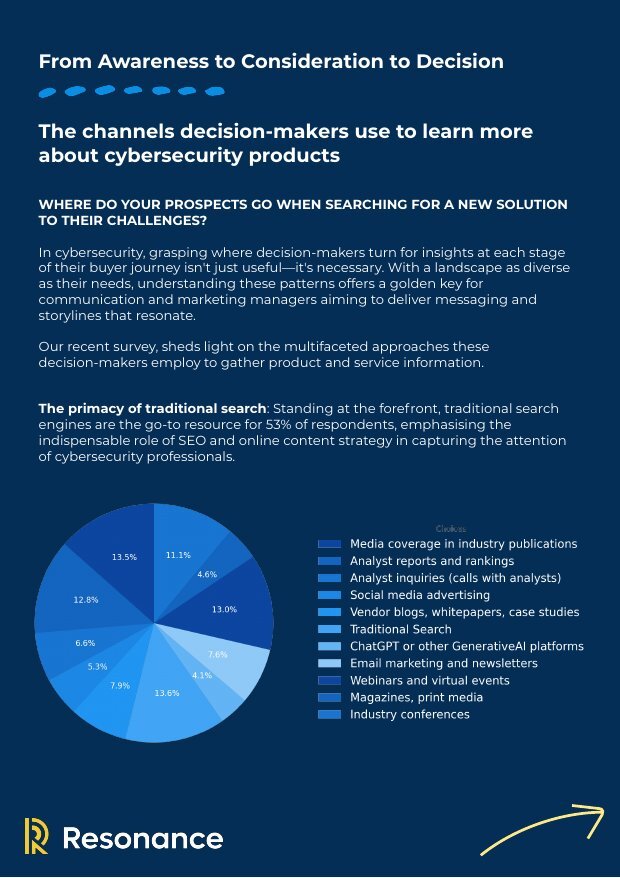
Where buyers research cybersecurity products.
When a buyer goes looking for something to fix a problem, search and the trade press are level at the front. Webinars and analyst reports follow within three points. We read that as buyers wanting to hear from someone other than the vendor before they talk to one.
Share of the 200 respondents who use each channel. They could choose several, so the figures add up to more than 100%.
A vendor's own material sits some way down the list. White papers, case studies and blogs reached 31% of buyers, level with email marketing, while social advertising and print were lower again. We wouldn't call owned content wasted on that evidence, although it suggests buyers read it once they have heard of you somewhere they trust more.
The AI figure is the one we'd watch. In 2024, 16% of these buyers used tools such as ChatGPT to research products, and assistants now draw up a good many shortlists. Our research on earned media in AI answers found that the assistants cite trade and specialist titles most often for B2B tech, so the coverage that reaches buyers directly also shapes what the assistants tell them.
Specialist news sites come first, and LinkedIn comes last.
To keep up with security trends, the decision-makers spread their attention across eight kinds of source, and none took more than 15% of mentions. Specialist cybersecurity and technology news sites led.
| Source for cybersecurity trends | Share of mentions |
|---|---|
| Cybersecurity and technology news sites | 14.2% |
| Professional networks | 13.9% |
| Industry reports from analysts | 13.7% |
| Online forums and communities | 12.9% |
| Conferences and webinars | 12.1% |
| Industry reports from vendors | 12.0% |
| Vendor websites and blogs | 11.6% |
| 9.5% |
Each source's share of all the answers given. Respondents could choose several sources.
We think LinkedIn came last because of trust. It carries a great deal of security content of very mixed quality, and people who may have to defend a decision to their board prefer sources with an editor or an analyst behind them. A LinkedIn presence still helps. It just can't be the plan on its own.
What gets a vendor onto the shortlist.
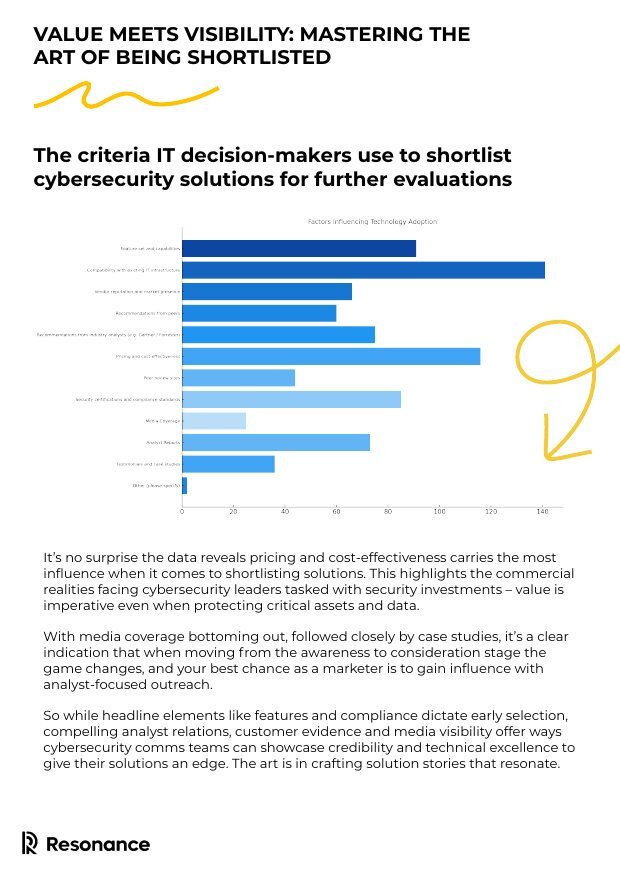
Shortlisting is where the product has to fit. Compatibility with existing infrastructure came first, ahead of price, features and security certifications, and marketing can do little about any of those four. Analysts are the exception.
Each criterion's share of all the answers given, with the two analyst criteria in the darker colour. Bars are drawn to scale against a maximum of 25%.
Among the things communications can influence, analysts come first by a distance. Recommendations from firms such as Gartner and Forrester took 9.2% of mentions and analyst reports another 9%, so together they outweigh every single criterion on the list, compatibility included. Asked which analyst firms they trusted most for insight, respondents named Gartner, Keypoint Intelligence and Everest Group.
Media coverage came last, with about 3%.
We wouldn't take that as a reason to stop pitching. Industry publications tied for first place when buyers were researching products, so coverage does its work earlier, by making sure a vendor is known before anyone writes a list. By the time the shortlist is drawn up, analysts and peers are doing more of the persuading.
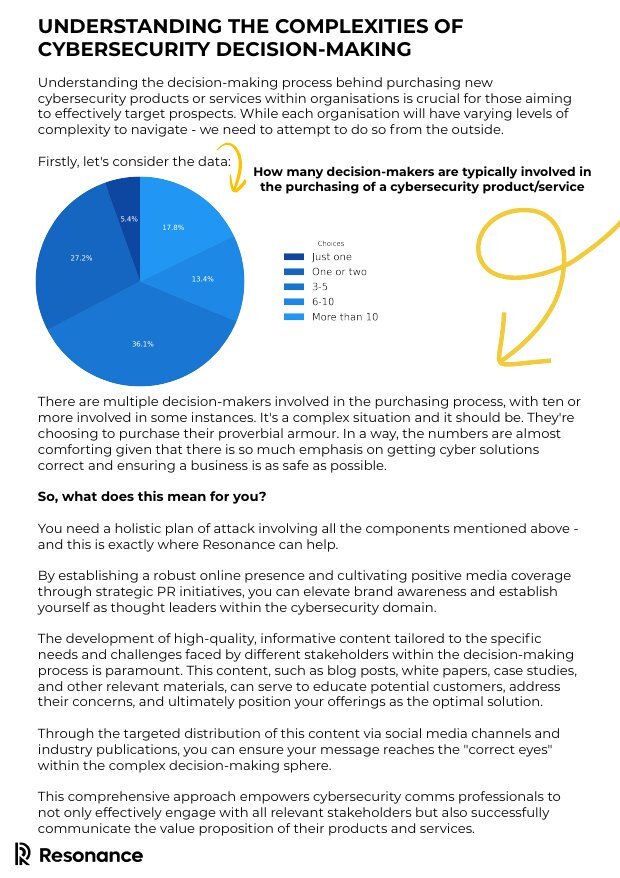
How many people are involved in buying cybersecurity.
Two thirds of respondents said three or more people take part in buying a cybersecurity product or service. Almost one in five said more than ten.
The survey offered "just one" and "one or two" as separate answers, and we show them as they were asked.
Each person in that group wants something different from a vendor. In our experience the CISO looks at threat coverage and architecture, while procurement wants terms and risk it can compare with other bids. The leadership team wants a choice it can defend if something goes wrong. You can't win all of them with one champion and a good sales deck, because most of the group has formed a view before the evaluation starts, from what they have read and what their peers say about you.
AI is the topic security buyers most want to hear about.
Asked which topics would dominate the year ahead, the decision-makers put AI in cybersecurity far in front, with 35.2% of mentions. Privacy and data protection law came second at 16%, then blockchain for security (11.9%) and threat intelligence sharing (11.7%). Quantum computing threats, zero trust and security orchestration, automation and response (SOAR) each took under 9%.
That creates a problem for vendors. When every security company is talking about AI, another general AI announcement disappears. We'd join the conversation where you have something specific to add, such as a use of AI in your product that a customer can check, or a view on how regulation will apply, and stay out of it where you don't, because buyers notice a vendor that's only there for the attention.
Budgets were steady. Four in ten respondents expected their cybersecurity budget to stay about the same in 2024, and among those expecting a change, more expected a rise than a cut.
How to reach cybersecurity buyers, based on what they told us.
You can't control which vendor a buying group chooses. You can control whether it has heard of you before the evaluation, and whether the analysts it trusts understand what you do.
Be findable where research starts
Search and the trade press share first place. Pages that answer buyers' questions plainly, together with regular coverage in the security titles they read, put you in front of about half of them before they contact anyone.
Brief the analysts early
Analysts carry more weight at the shortlist than anything else you can influence. Brief the firms your buyers trust before an evaluation begins, as our analyst relations guide describes, because a vendor the analyst already understands is easier to recommend.
Write for the whole buying group
Plan content for each role in the group. A CISO wants technical depth and procurement wants something it can compare with other vendors. The same story should sit underneath both.
Turn up where buyers meet
Webinars reached 51% of buyers and conferences 43%. A talk or a demonstration lets a sceptical audience judge your people for themselves, which an advert can't.
We run this kind of programme for cybersecurity companies. For start-ups, our early-stage cybersecurity PR playbook covers coming out of stealth, funding announcements and the first analyst briefing.
Read it in full.
The fifteen-page white paper we published in 2024, Controlling the controllable, has every chart from the survey. It's free, and there's no form to fill in.
Download the PDF- Pages
- 15
- Format
- PDF, 5.7 MB
- Published
- 2024
Try it with AI by asking an assistant to apply the findings to your own company.
More research for security marketers.
The early-stage cybersecurity PR playbook
When to come out of stealth, how to announce a funding round and when to start analyst relations.
Earned media in the age of AI answers
Which media titles the AI assistants read for B2B tech, and why trade and specialist press come out on top.
What AI reads before it recommends
The content types and page features that AI assistants cite most, from over 1.3 million citations.
Cybersecurity buyer statistics.
All of these come from our survey of 200 cybersecurity decision-makers, published in March 2024.
- 53%use search engines to research cybersecurity products, and 53% use industry publications.
- 51% / 43%use webinars and virtual events, and industry conferences.
- 50%are influenced by analyst reports and rankings.
- 31%turn to vendors' white papers, case studies and blogs.
- 16%used AI tools such as ChatGPT to research products in 2024.
- 18.2%of shortlisting mentions went to analyst recommendations and reports combined, more than any single criterion.
- 67%say three or more people take part in a cybersecurity purchase, and 17.8% say more than ten.
- 9.5%of mentions went to LinkedIn, last of eight sources for following security trends.
If you're citing this research, you're welcome to use these figures, and we'd ask you to credit and link to the source: Resonance (2024), Controlling the controllable: how marketers can effectively engage cybersecurity decision-makers. https://www.resonancecrowd.com/new/research/where-cybersecurity-buyers-look
Questions about how cybersecurity buyers choose vendors.
Where do cybersecurity decision-makers research new products?
Search engines and industry publications came first in our survey, each used by 53% of the 200 decision-makers we asked. Webinars and virtual events (51%) and analyst reports and rankings (50%) were close behind. A vendor's own white papers, case studies and blogs reached 31%.
What do cybersecurity buyers look at when they shortlist vendors?
The product has to fit first, with compatibility with existing infrastructure, price, features and certifications at the top of the list. Of the factors a marketing team can influence, analysts count for most. Analyst recommendations and analyst reports together took 18.2% of mentions, more than any single criterion.
How many people are involved in buying cybersecurity?
Two thirds of the decision-makers we surveyed said three or more people take part, and 17.8% said more than ten. In our experience that group spans security, IT, procurement and finance as well as senior leadership, and each of them needs a reason to trust the vendor.
Does media coverage help a cybersecurity vendor get shortlisted?
Not directly. Media coverage came last of the shortlisting criteria, with about 3% of mentions, although industry publications tied for first place as somewhere buyers research products. Coverage does its work before the shortlist exists, by making sure buyers have heard of you.
Do cybersecurity professionals use LinkedIn to follow security trends?
Less than any other source we asked about. LinkedIn came eighth of eight, with 9.5% of mentions, while specialist cybersecurity and technology news sites came first with 14.2%, ahead of professional networks and analyst reports.
How was the research done?
We surveyed 200 cybersecurity decision-makers, in roles from CIOs and CDOs to IT managers, and published the results in March 2024. Respondents could choose more than one answer to most questions. Where we quote a share of mentions, it is that answer's share of all the answers given.
Be known before the shortlist is written.
We run PR, analyst relations and content for cybersecurity companies, planned around where their buyers look at each stage. If you'd like to talk about yours, we'd be glad to hear from you.
Talk to Resonance More research