Earned media in the age of AI answers.
We analysed over 1.3 million citations in AI answers to find out which publications ChatGPT, Gemini and Perplexity read when B2B technology buyers ask for advice. We began expecting the big national titles to lead, and found that once buyers start choosing a supplier, the trade press supplies most of the media the assistants cite. If you're planning PR for AI search, that makes the trade press the natural place to start.
- Citations
- Over 1.3 million, over 11 months
- AI answers
- Almost 190,000
- Brands
- 116 in B2B technology
- Assistants
- ChatGPT, Gemini, Perplexity, Claude and others
We expected the national headlines to lead.
Most PR plans still put the big national titles at the top of the list, and we assumed the AI assistants would read the media in much the same way. Media turned out to be a small part of what they cite, at about one citation in every 25, with company websites making up most of the rest. Within that share a consistent pattern emerged, and it pointed away from the national press on the questions that decide who gets shortlisted.
- 3 in 4
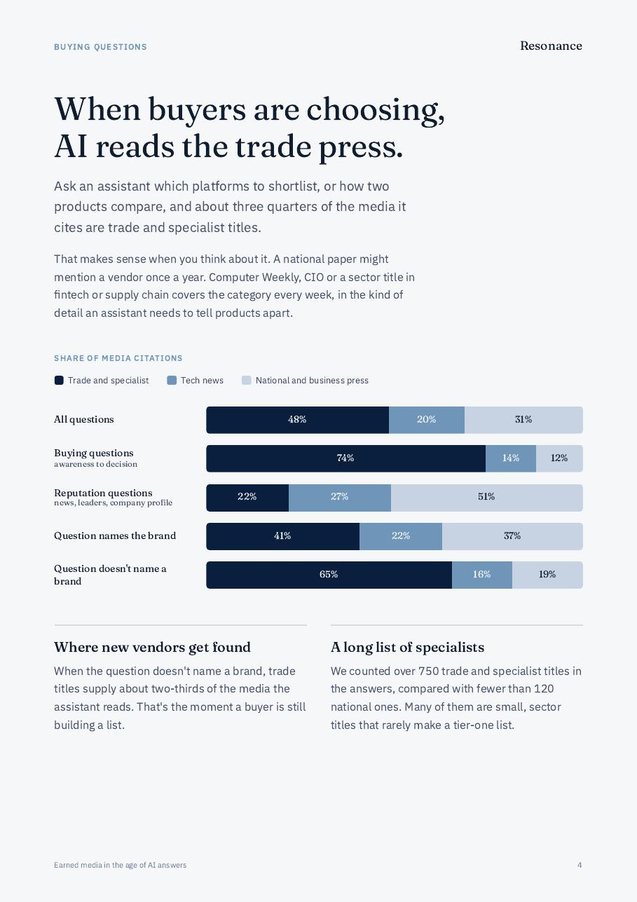
- media citations on buying questions come from trade and specialist titles
- 2 in 3
- media citations on questions about a company's leaders and reputation come from the national press
- 6 of 20
- top media titles are shared by ChatGPT and Gemini
- 9 months
- is roughly how old a trade article is when AI cites it
Source: Resonance analysis of Agentcy AI visibility data, October 2025 to September 2026.
When buyers are choosing, AI reads the trade press.
When someone asks an assistant which platforms to shortlist, or how two products compare, about three quarters of the media it cites are trade and specialist titles. Part of the reason is the volume and depth of coverage. A national paper might mention a vendor once a year, whereas Computer Weekly or CIO covers the category every week and explains how products differ in the kind of detail an assistant needs to compare them.
Bars show each group's share of media citations. We counted over 750 trade and specialist titles in the answers, compared with fewer than 120 national ones.
National press still owns the questions about who you are.
The reading list changes with the question being asked. When someone asks about a company's leaders or its reputation, the national and business press returns to the front and supplies about two-thirds of the media citations. These answers also draw on a much shorter list of sources, and a handful of well-known names account for most of the citations. A vendor evaluation, by comparison, can draw on several hundred titles, most of them specialist.
Each assistant has its own reading list.
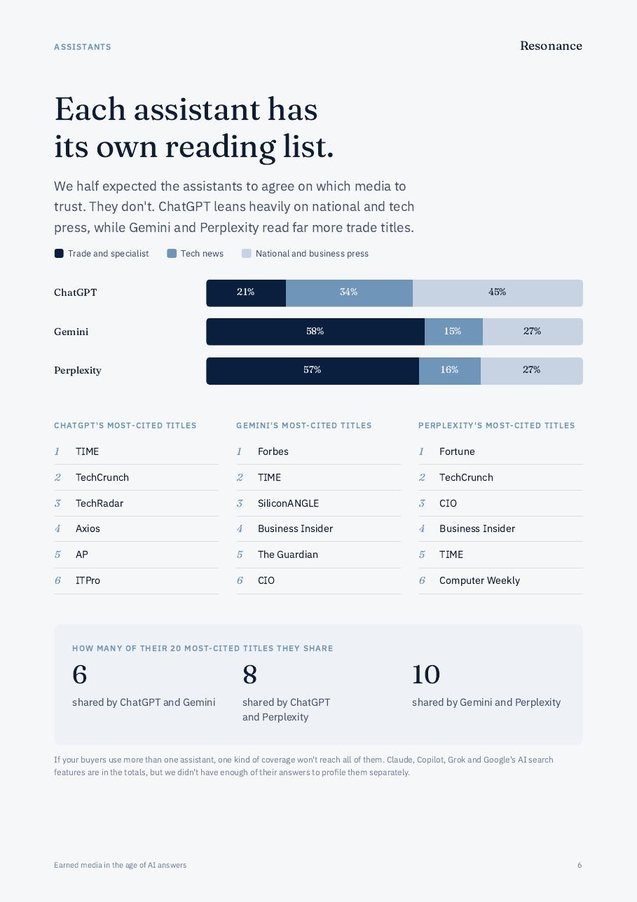
We had half expected the assistants to agree on which media to trust, and the data showed that they differ a good deal. ChatGPT draws most of its media citations from national and tech press, and the trade share is far higher in Gemini and Perplexity, which cite trade titles for well over half of theirs. ChatGPT and Gemini have only six titles in common among the 20 that each of them cites most. A media plan built around one type of coverage is therefore likely to reach buyers on some assistants and miss them on others.
The totals also include answers from Claude and Copilot, as well as Grok and Google's AI search features, but we didn't have enough of their answers to profile them separately.
These are the titles AI cited most.
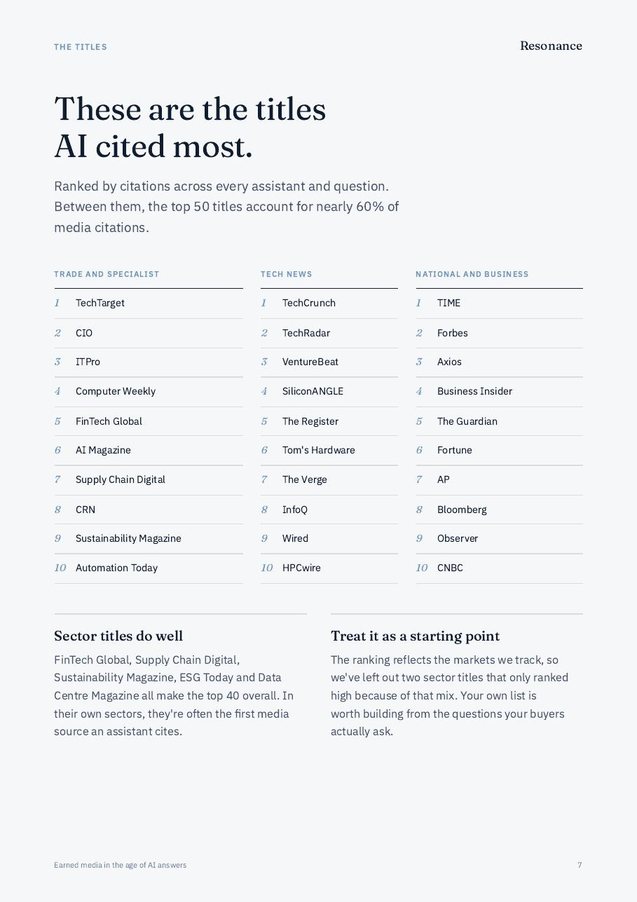
The lists below rank titles by citations across every assistant and question type, and they work best as a starting point for your own planning. They reflect the markets we track, which lean towards enterprise software and fintech, as well as security and AI, so we have left out two sector titles that ranked highly only because of that mix. The most useful list for your programme will come from the questions your own buyers ask.
Trade and specialist
- TechTarget
- CIO
- ITPro
- Computer Weekly
- FinTech Global
- AI Magazine
- Supply Chain Digital
- CRN
- Sustainability Magazine
- Automation Today
Tech news
- TechCrunch
- TechRadar
- VentureBeat
- SiliconANGLE
- The Register
- Tom's Hardware
- The Verge
- InfoQ
- Wired
- HPCwire
National and business press
- TIME
- Forbes
- Axios
- Business Insider
- The Guardian
- Fortune
- AP
- Bloomberg
- Observer
- CNBC
Trade articles keep working for months.
Tech news is cited while it is fresh, usually within a few weeks of publication. Trade articles stay in use for much longer. The typical one was about nine months old when an assistant cited it and a good number were more than a year old, so a well-placed trade feature can keep appearing in answers long after the launch it covered.
Media's share of all citations also moved during the year, peaking at nearly 7% in February and falling below 3% over the summer, when the assistants leant more heavily on company websites, before recovering to about 4% in September.
- 18 days
- typical age of a tech news article when AI cites it
- 8 weeks
- for the national and business press
- 9 months
- for trade and specialist titles (from a small sample of dated articles)
How to use PR to get cited in AI answers.
Our reading of the data is that most B2B technology programmes should give trade and specialist titles a larger share of their time and budget. The six changes below are the ones we would make first.
Give the trade titles more time
Treat the specialist titles in your sector as priority targets, give them regular briefings and data they can use in their own reporting, and offer bylined articles where a title accepts them.
Build the list from real questions
Ask the assistants the questions your buyers ask, note which titles they cite and build your target list from those, which will usually be longer and more specialist than a traditional tier-one list.
Cover more than one assistant
Because the assistants weight the media differently, a plan that reaches buyers on every assistant needs both national and trade coverage in the mix.
Use the nationals for reputation
Questions about the company and its leaders are where national coverage appears most in AI answers, so aim those stories at the titles the assistants cite for reputation.
Give journalists the detail
Assistants tend to cite articles that explain how products compare and which systems they work with, and editors can only write those pieces if you give them specific customer evidence and numbers.
Check what gets cited
Alongside reach and readership, track whether your coverage appears in AI answers, which questions it appears for and on which assistant, so you can see which titles are shaping what buyers read.
Read it in full.
The PDF runs to eleven pages and includes the full charts and top-ten lists, with a note at the end on how we did the analysis. It's free to download, and there's no form to fill in.
- Pages
- 11
- Format
- PDF, 0.8 MB
- Data
- Oct 2025 to Sep 2026
Explore it with AI by asking an assistant what the findings mean for your own category.
Two more reports from the same data.
What AI reads before it recommends
Our study of which kinds of pages the assistants cite for B2B technology, and what the most-cited pages have in common.
What AI gets wrong about B2B tech brands
We checked almost 50,000 AI answers against the facts to find the mistakes assistants make about B2B tech companies and where they come from.
B2B tech PR, built for AI search
This is how we run media relations for technology companies, with AI visibility measured throughout the programme.
Earned media and AI search statistics.
These are the headline numbers from the report, rounded to whole figures. All of them come from over 1.3 million citations in answers to buyer questions about 116 B2B technology brands between October 2025 and September 2026.
- About 4%of AI citations point to a news, tech or trade publication. Most of the rest are company websites.
- 48%of media citations go to trade and specialist titles. National and business press take 31% and tech news the remaining 20%.
- 3 in 4media citations on buying questions come from trade and specialist titles. The national press gets about one in eight.
- 2 in 3media citations on questions about a company's leaders and reputation come from the national press.
- 900+media titles are cited in the answers; more than 750 of them are trade or specialist publications.
- 6 of 20top media titles are shared by ChatGPT and Gemini. For ChatGPT and Perplexity the overlap is eight.
- 45%of ChatGPT's media citations go to national and business press. The figure for Gemini and Perplexity is 27%.
- 9 monthsis the typical age of a trade article when AI cites it. Tech news is cited at about 18 days old.
Our blog post on the B2B tech trade publications AI cites most groups the titles into six sectors, among them security and fintech.
If you cite this research, you're welcome to use these figures as long as you credit and link to the source: Resonance (2026), Earned media in the age of AI answers. https://www.resonancecrowd.com/research/earned-media-in-ai-answers
Common questions about earned media and AI.
Which media do AI assistants cite most for B2B technology?
In our data, the most-cited titles overall were TIME, Forbes, TechCrunch, TechRadar and Axios. Among trade publications, TechTarget, CIO, ITPro and Computer Weekly led, with sector titles such as FinTech Global and Supply Chain Digital close behind. The right list for your company will depend on the market you sell into.
Is trade media important for AI search?
Yes, and it is the part of the press that AI relies on most when buyers are choosing a supplier. On questions such as vendor evaluations, product comparisons and compliance checks, about three in four media citations went to trade and specialist titles, compared with roughly one in eight for the national press.
Do ChatGPT, Gemini and Perplexity cite the same media?
Only to a limited extent, since ChatGPT draws mostly on national and tech press and the other two lean towards trade titles. ChatGPT and Gemini share only six of their 20 most-cited media titles, which means coverage that appears in one assistant's answers may not appear in the other's.
Is national press coverage still worth it for B2B tech brands?
It is, mainly for questions about reputation. When someone asks an assistant about a company's leaders or its reputation, the national and business press supplies about two-thirds of the media it cites. On buying questions the national share falls to about one in eight, while trade titles take most of the rest.
How much of an AI answer comes from earned media?
About 4% of citations point to a media title of some kind, and most of the rest go to company websites. The share is small, but it is one of the few independent sources in a typical answer, so its value to your reputation is greater than the percentage suggests.
How long does coverage keep getting cited by AI?
Trade coverage lasts longest, and in our sample the typical trade article was about nine months old when an assistant cited it. Around four in ten were more than a year old, whereas tech news was usually cited within a few weeks of publication.
Does PR help you show up in ChatGPT and other AI assistants?
Yes, because media coverage is one of the few independent sources AI cites about a company. In our analysis of over 1.3 million AI citations about B2B tech brands, about 4% pointed to media titles, and on buying questions three quarters of those were trade and specialist titles. Coverage in the titles your buyers' assistants read makes it more likely that you're described, and recommended, the way you would want.
Which B2B tech trade publications does AI cite most?
In our data the most-cited trade and specialist titles were TechTarget, CIO, ITPro and Computer Weekly, followed by sector titles such as FinTech Global, AI Magazine, Supply Chain Digital, CRN and Sustainability Magazine. The right list for you depends on your market and the questions your buyers ask.
What is earned media in AI search?
Earned media is coverage you don't pay for, such as articles and interviews written by journalists and editors. In AI search, it is the coverage that the assistants read and cite when they answer questions about your market. It sits alongside your own website and third-party pages such as review sites and forums.
How was the research done?
We used Agentcy, our AI visibility platform, to collect over 1.3 million citations from almost 190,000 AI answers between October 2025 and September 2026. The answers came from buyer-style questions about 116 B2B technology brands. We sorted the cited websites into source types and divided the media between the national and business press, technology news sites and the trade press.
Find out which titles AI reads for your category.
Tell us who you are and we'll put your buyers' questions to the main AI assistants. We'll send you a short snapshot of which publications they cite, and whether you're in them.
The snapshot is free and comes with no obligation, and we run it with Agentcy, the platform behind this research.
By submitting this form, you agree to our privacy policy.