What AI reads before it recommends.
When a buyer asks an AI assistant which software to shortlist, the answer comes with sources. We went through over 1.3 million of them, cited over 11 months in answers about 116 B2B technology brands, to see what the assistants actually read.
- Citations
- Over 1.3 million
- Period
- October 2025 to September 2026
- Brands
- 116 B2B technology brands
- Assistants
- ChatGPT, Gemini, Perplexity and more
AI mostly reads what companies publish.
The assistants lean on company websites far more than anything else. Which pages they pick, and how those pages are built, follows a pattern you can plan around.
- 83%
- of citations point to company websites. Media, review sites, forums, video and everything else share the other 17%.
- 22%
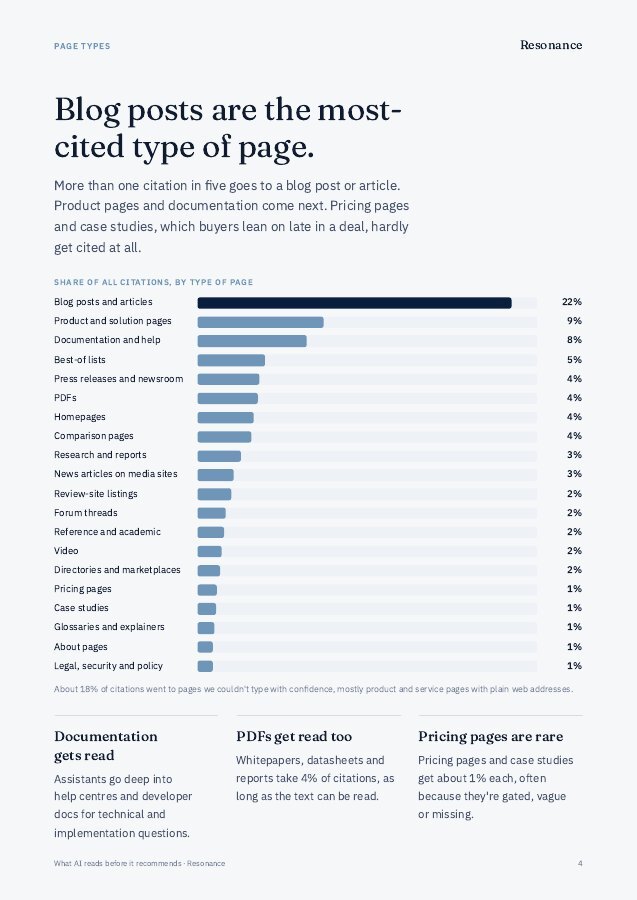
- go to blog posts and articles, the biggest single type of page. Product pages and documentation come next.
- 6%
- of citations go to a brand's own site when the question doesn't name the brand. When it does, the figure is 29%.
- 1%
- of pages earn 30% of all citations. Most pages are cited once and never again.
- +36%
- more citations, on average, for pages with FAQ markup. Visible dates, lists, tables and length all go with more citations too.
- 5 months
- is the typical age of a dated page when it's cited. Four in ten were less than three months old.
Source: Resonance analysis of Agentcy data, October 2025 to September 2026. Figures rounded.
Most citations go to company websites.
About two-thirds of citations go to other companies' websites: vendors, competitors, partners and service firms writing about your category. About a sixth go to the brand's own site.
Everything else, from review sites and forums to the press and YouTube, adds up to about 17%. That's a smaller slice than a lot of PR and SEO plans assume. It's also where the assistants go for a view that isn't the vendor's own, so we've covered the media side separately in Earned media in the age of AI answers.
- 66%
- Other companies' websites
- 17%
- The brand's own website
- 2% each
- Review sites, trade media, forums, reference sites and YouTube
- 1% each
- National press, blogging platforms, government sources and consultancies
When buyers ask about the category, someone else writes the comparison.
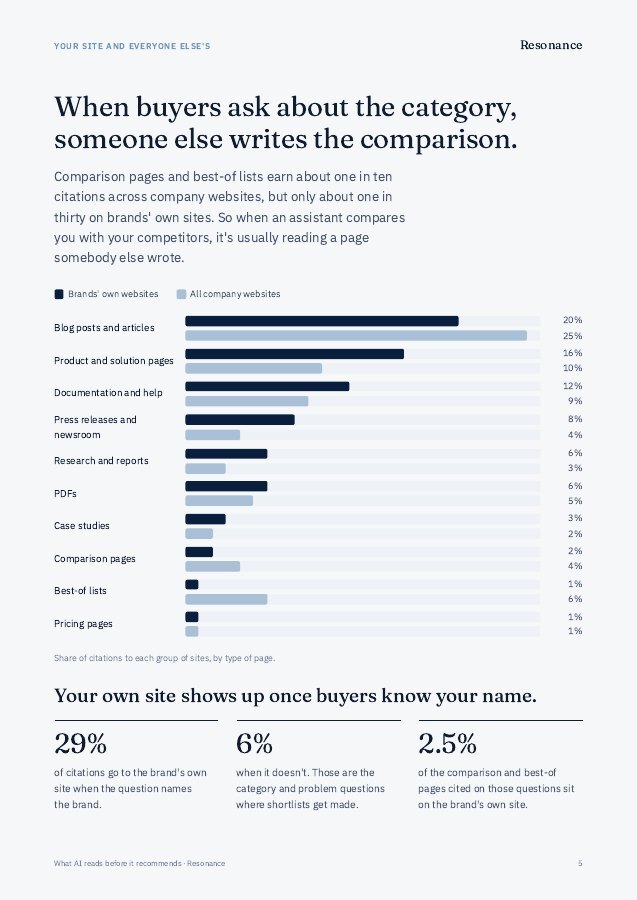
Blog posts are the most-cited type of page. Comparison pages and best-of lists earn about one in ten citations across company websites, but only about one in thirty on brands' own sites. So when an assistant compares you with your competitors, it's usually reading a page somebody else wrote.
Blog posts come first
Blog posts and articles take 22% of all citations. On brands' own sites, product pages (16%) and documentation (12%) come close behind.
Documentation and PDFs get read
Help centres and developer docs are cited for technical questions. Whitepapers and reports take 4% of citations, as long as the text can be read.
Pricing pages and case studies are rare
About 1% of citations each, often because the pages are gated, vague or missing. Buyers still ask about both, so the assistants fill the gap from elsewhere.
- 29%
- of citations go to the brand's own site when the question names the brand
- 6%
- when it doesn't: the category and problem questions where shortlists form
- 2.5%
- of the comparison and best-of pages cited on those questions sit on the brand's own site
- 31%
- of citations go to pages that three or more different assistants cite
Pages with FAQs, dates and more depth get cited more.
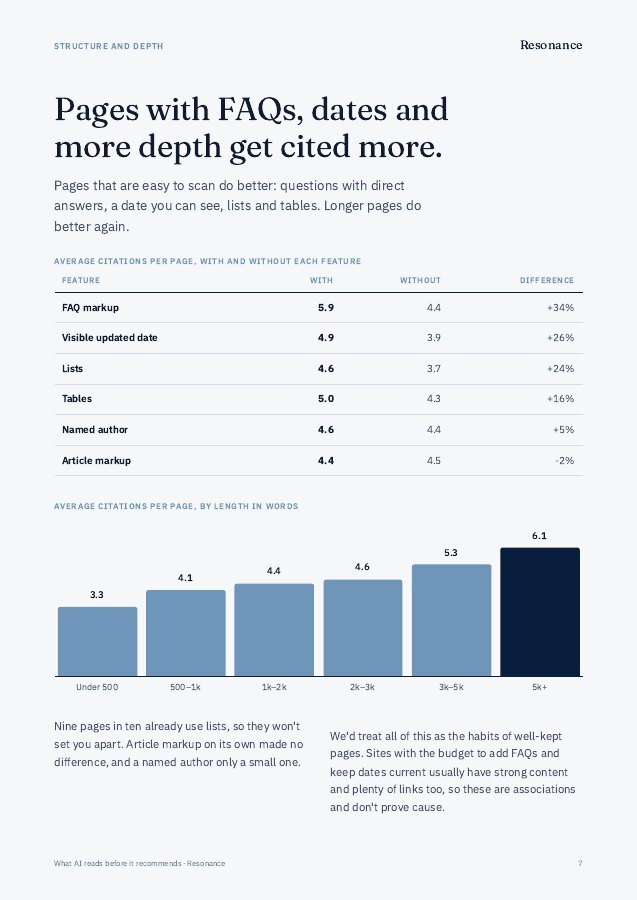
A small number of pages earn most citations: the top 1% take 30% of them. We audited about 190,000 cited pages to see what the popular ones share. Pages that are easy to scan do better, and longer pages do better again.
- +36%
- more citations for pages with FAQ markup (5.9 on average, against 4.4)
- +26%
- more for pages that show when they were last updated
- +24%
- more for pages with lists. Nine pages in ten have them, so they're the baseline
- +16%
- more for pages with tables
- 6.1 vs 3.3
- average citations for pages over 5,000 words, against pages under 500
- No change
- from article markup on its own. A named author makes only a small difference
We'd treat these as the habits of well-kept pages. Sites with the budget to add FAQs and keep dates current usually have strong content and plenty of links too, so these are associations and don't prove cause.
Buyers see different pages at each stage and in each assistant.
Early on, the assistants pull in best-of lists. As buyers get closer to a decision they reach for evidence: review listings, pricing, case studies and PDFs. Your own site shows up more at every step, from 6% of citations at awareness to 20% at the decision stage.
Each assistant reads different content too. ChatGPT goes to documentation and product pages and hardly touches best-of lists or comparisons. Perplexity and Gemini read far more blogs, lists and comparisons. Ask two assistants the same question and the answers may be built from quite different pages.
- 7% → 4%
- best-of lists' share of citations, awareness to decision
- 1% → 2%
- case studies, and pricing pages likewise, as buyers get closer
- 30%
- of ChatGPT's citations go to documentation and product pages, against about 10% for Perplexity
- 14%
- of Perplexity's citations go to best-of lists and comparison pages. ChatGPT: under 2%
Assistants are citing brands' own sites more often.
Over 11 months, the brand's own site went from about one citation in twelve to one in five. The rise shows up whether or not the question names the brand, so the mix of questions doesn't explain it. Comparison pages grew too, from about 1% of citations to 5%, and PDFs from almost nothing to about 4%.
Most cited pages are less than a year old. The typical dated page was about five months old when cited, and only 6% were more than three years old. News gets cited while it's news, while trade features, forum threads and company pages stay in use for months.
- 8% → 21%
- own-site share of citations, late 2025 to Q3 2026
- 0.6% → 2.1%
- YouTube's share over the same period
- 1.0% → 2.3%
- forums and communities, mostly Reddit
- 2.7% → 1.5%
- reference sites such as Wikipedia, falling
What we'd do about it.
You don't need a new team for any of this. It's mostly about what you publish, how you lay it out and how often you go back to it.
Write for the question that doesn't name you
Category and “best tool for” questions are where shortlists form. There, your site gets about 6% of citations.
Publish your own comparisons
Fair pages comparing you with named alternatives, and pages on who you're best for. Otherwise the assistants read someone else's.
Treat documentation as marketing
Docs earn about one in eight citations to brands' own sites. Keep them public, current and easy to crawl.
Put the answer first
Questions with direct answers, tables, clear headings and a visible date.
Go deep on fewer pages
Build the reference page for your subject and keep improving it. 1% of pages take 30% of citations.
Refresh on a schedule
Four in ten cited pages were under three months old. Review key pages every quarter and show the date.
Make your evidence readable
Reports behind a form or inside images are invisible to an assistant.
Earn the pages you can't write
Review sites, trade media, forums and best-of lists fill the gaps between vendor pages. That's PR's job.
Read it in full.
Twelve pages on where citations go, which page types win at each stage and for each assistant, what the most-cited pages have in common, how fresh they are and what changed over the year. Free, with no form to fill in.
Download the PDF- Pages
- 12
- Format
- PDF, 1 MB
- Data
- Oct 2025 to Sep 2026
Try it with AI. Ask an assistant what the findings mean for your own website.
More from the same data.
Earned media in the age of AI answers
The press, trade titles and specialist media the assistants cite, and why each one reads a different list.
What AI gets wrong about B2B tech brands
The errors in AI answers, the patterns behind them, and whether they start on your site or somewhere else.
The UK B2B Tech PR AI Visibility Index
Which UK B2B tech PR agencies the assistants recommend, measured every week.
Questions about AI citations.
What content do AI assistants cite most when B2B buyers ask for advice?
Company websites. In Resonance's analysis of over 1.3 million citations in AI answers about 116 B2B technology brands, about 83% pointed to company websites: two-thirds to other companies' sites and a sixth to the brand's own. By type of page, blog posts and articles led with 22% of citations, followed by product pages (9%) and documentation (8%).
How often do AI assistants cite a company's own website?
About 17% of citations went to the brand's own site. That rises to 29% when the question names the brand, and falls to 6% when it doesn't. The share grew over the year, from about 8% of citations in late 2025 to 21% by the third quarter of 2026.
Does FAQ schema help a page get cited by AI?
Pages with FAQ markup were cited 36% more often on average than pages without it. Pages with a visible updated date were cited 26% more, pages with lists 24% more and pages with tables 16% more. These are associations and don't prove cause, since well-resourced sites tend to do all of these things.
Does content length matter for AI citations?
Yes. Pages over 5,000 words averaged about 6 citations each, against about 3 for pages under 500 words. The most-cited 10% of pages had a median of about 1,700 words and more headings than pages cited only once.
How recent are the pages AI assistants cite?
For pages with a detectable publish date, the typical page was about five months old when cited. Four in ten were under three months old and three in four under a year. News goes stale fastest: technology news was typically cited within about 18 days of publication, while trade features and company pages stayed in use for months.
Which third-party sites do AI assistants cite for B2B technology?
Beyond company websites, the assistants cite review sites such as G2, Capterra and PeerSpot, forums such as Reddit and Hacker News, Wikipedia and arXiv, YouTube, blogging platforms such as Medium and Substack, and trade, technology and national media. Together these make up about 17% of citations. Each assistant has its own mix: Gemini and Perplexity cite YouTube and Reddit, while ChatGPT hardly cites video.
Do different AI assistants cite different types of content?
Yes. ChatGPT leans on documentation (16% of its citations) and product pages (14%) and barely cites best-of lists or comparison pages. Perplexity cites blog posts for 29% of its citations, best-of lists for 8% and comparison pages for 6%. Gemini and Perplexity also cite YouTube and Reddit, which ChatGPT rarely does.
How was the research done?
Agentcy, Resonance's AI visibility platform, asked ChatGPT, Gemini, Perplexity and other assistants the questions B2B buyers ask, and recorded every source cited. The data covers almost 190,000 answers to about 67,000 questions between October 2025 and September 2026. Cited sites and pages were sorted by type, and about 190,000 cited pages were audited for their features.
Find out which pages the assistants read for your category.
Agentcy shows which pages AI assistants cite for your buyers' questions, yours and everyone else's. Resonance turns that into a content and PR plan.
Talk to Resonance More research