The new early-stage cybersecurity PR playbook.
From stealth to category credibility. When to go public, how to make the funding round count, why analyst relations should start early, and how to make technical messaging work in the mainstream press.
- For
- Cybersecurity founders and CMOs
- Stage
- Early stage, from stealth
- Format
- 20-page PDF
- Published by
- Resonance and Agentcy
The narrative gap that’s costing you deals.
Cybersecurity used to reward the best product: buyers felt it in a proof of concept and word spread through practitioner networks. AI has compressed the development cycle, and that world has gone.
The speed problem
The gap between a novel architecture and a commoditised one is now measured in months. Competitors build faster, and their investors are better resourced.
The buyer problem
Buyers use AI assistants, alongside analyst reports and peer referrals, to draw up a first shortlist of suppliers before your sales team gets a call.
The narrative gap
The distance between the quality of your technology and the credibility of your public story. Where trust is the product, that gap is a commercial problem.
Four moments that decide your reputation.
Each part is meant to be used: taken into a team meeting, tested against your current plan and turned into a decision.
Coming out of stealth
Timing is strategy. Three questions to ask before you go public, and why a rival’s first story is so hard to dislodge.
Funding announcements
Lead with the problem, brief one tier-one journalist under embargo and plan eight weeks of follow-on content.
Analyst relations
Two myths that keep start-ups waiting, how to run a first briefing, and what to send ahead of it.
Technical messaging
The four-part failure pattern, the message hierarchy fix and the dual-audience test for your spokespeople.
Five things to take away.
The short version. The playbook goes further on how to do each one.
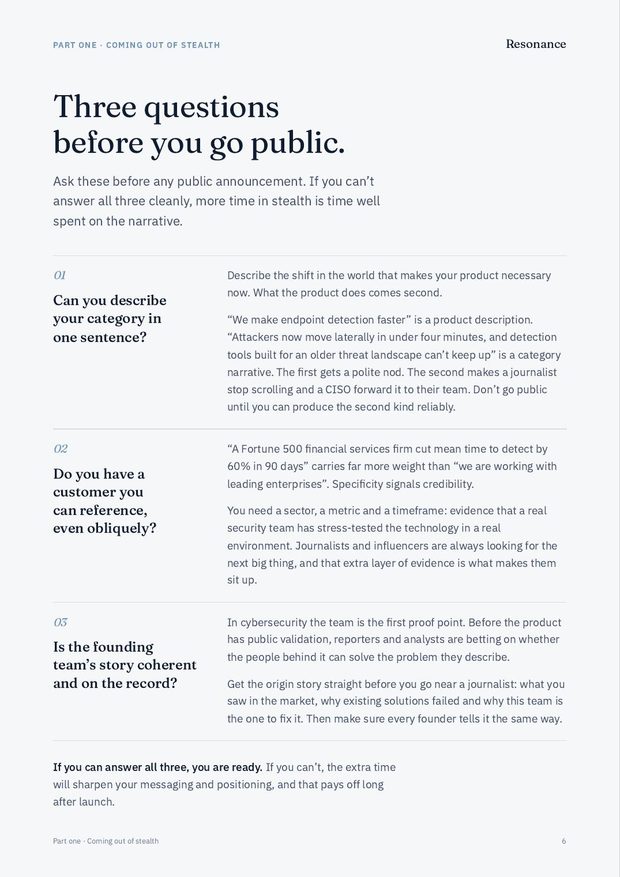
- Exit stealth on narrative readiness
- Go public when you can state your category in one sentence, name a customer you can reference and tell one consistent founding story.
- Make the funding round work harder
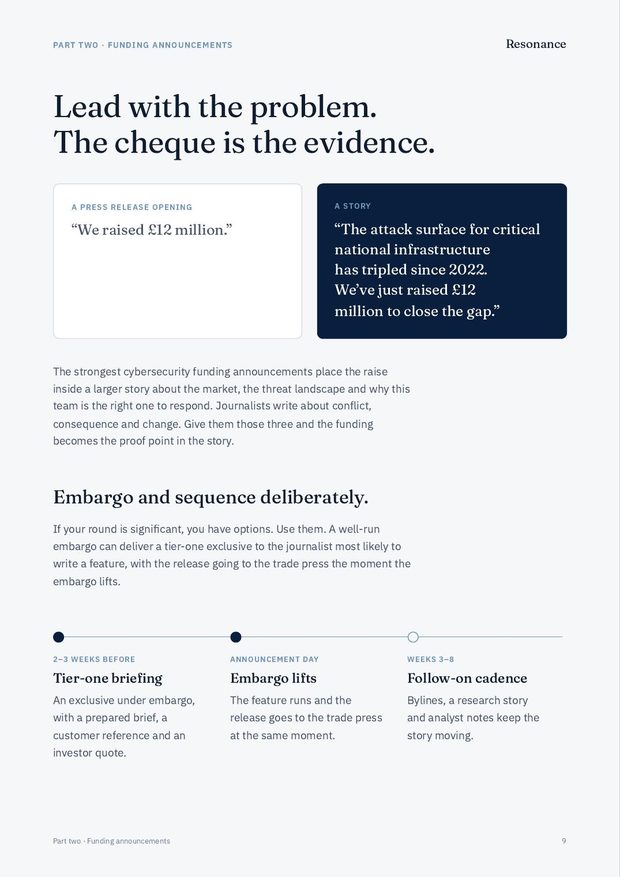
- Put the raise inside a story about the market and the threat. Journalists write about conflict, consequence and change.
- Start analyst relations early
- Analysts shape shortlists before a formal evaluation begins. Get into their vocabulary while the category is still forming.
- Translate the technical message
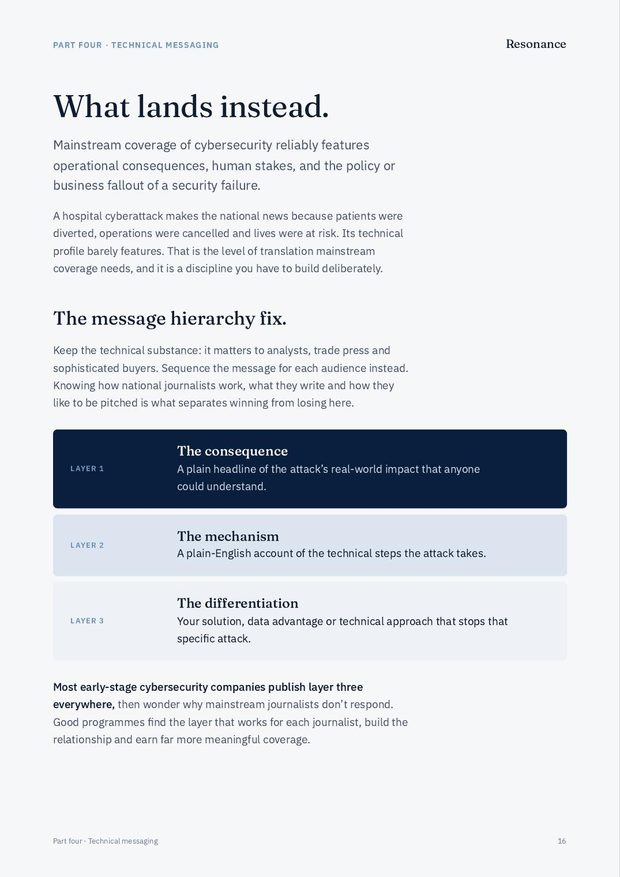
- Consequence first, then the mechanism in plain English, then what makes you different. Most start-ups publish only the last layer.
- Build credibility every quarter
- Every briefing, byline and proof point adds to the record, and the record is what buyers, analysts and AI assistants read.
You can’t reclaim a category story that someone else has already filed.
One PR team from stealth to scale.
We run the programme the playbook describes for cybersecurity companies, with Agentcy tracking the journalists, analysts and AI answers that shape your category.
Get the story ready
A category sentence, a referenceable proof point and one founding story every founder tells the same way, tested before anyone goes public.
Make the launch count
A tier-one exclusive under embargo, a trade release when it lifts and a follow-on plan of bylines, research and analyst notes.
Brief the analysts early
Firm and analyst selection, briefing preparation, the one-page problem statement and the follow-up. See our analyst relations guide.
Train the spokespeople
Media training built on the message hierarchy, so your CTO can brief Forrester at 10am and a national broadcaster at 2pm.
Read it in full.
Twenty pages covering the three diagnostic questions, the embargo runbook, the follow-on content plan, the first analyst briefing and the message hierarchy. Free, with no form to fill in.
Download the PDF- Pages
- 20
- Format
- PDF, 1.1 MB
- For
- Founders and CMOs
Explore it with AI. Ask an assistant to apply the playbook to your own launch.
Cybersecurity PR, briefly.
When should a cybersecurity startup come out of stealth?
When the story is ready. Check three things first: you can describe your category in one sentence, you have a customer you can reference (even anonymously, with a sector, a metric and a timeframe), and every founder tells the same origin story. A closed funding round is a weak trigger on its own.
How do you make a cybersecurity funding announcement work harder?
Lead with the market problem and treat the raise as the evidence. Brief one tier-one journalist under embargo two to three weeks ahead, release to the trade press when the embargo lifts, and plan follow-on content for weeks three to eight: a byline, a data-led research story and an analyst note.
When should an early-stage security company start analyst relations?
Before it feels ready. Analysts shape shortlists long before a formal evaluation, and you can brief them without a research contract. Prepare a 20-minute narrative, leave 20 minutes for questions, send a one-page problem statement ahead and follow up within 48 hours.
Why does technical messaging fail in mainstream press?
It leads with architecture, uses jargon a general reader cannot decode, measures in metrics they cannot evaluate and buries the human consequence. Reorder it: the real-world consequence first, then the mechanism in plain English, then what makes you different.
Close the narrative gap before a competitor does.
Resonance runs PR, analyst relations and spokesperson training for cybersecurity companies from stealth to scale. The competitive clock is already running.
Talk to Resonance More research