
 "The intricacies of the data-driven landscape is written into the DNA of Resonance. We are built for the data economy."
.jpeg?width=250&height=181&name=AdobeStock_565367297%20(1).jpeg)
 "In Tech PR we have a front row seat to the changing technology landscape. From Generative AI to Quantum, it's our job to insert our clients' voices into the narrative"



 "In a world where the only constant is change, how do tech brands stay one step ahead of the market? That's where Resonance comes in"
.png?width=219&height=219&name=Seb%20Moss%20wavelength%20thumbnail%20(1).png)




Controlling the controllable
How marketers can effectively engage cybersecurity decision-makers in 2025
A comprehensive guide to creating an effective cybersecurity communications programme that attracts the attention of prospects in 2025.

Decoding Your Prospect's Info-Diet: Navigating Cybersecurity Consumption Trends
Content across the stages: Knowing the buyer journey
When it comes to cybersecurity consumption habits, it is critical to understand that information on certain topics is consumed in different locations at different times in the buyer journey. To help you figure out where content needs to go at what point in the buyer journey, we’ve split this information into three buckets: information on cybersecurity issues and trends; information on products; and information to shortlist solutions.
Cybersecurity Trends
How decision-makers typically get information about cybersecurity trends
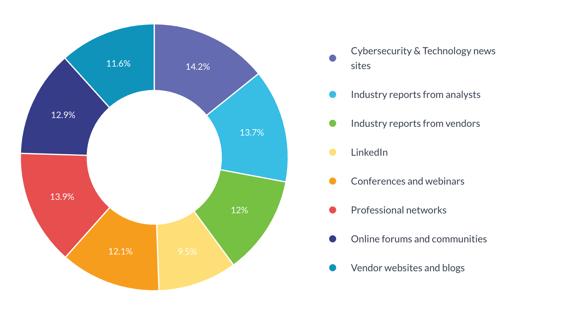
Our research of 200 cybersecurity professionals shows that cybersecurity and technology news sites are the most popular source to keep up with the latest cybersecurity trends. And let's face it, there's a lot to keep on top of.
Dedicated news platforms focusing purely on cybersecurity and emerging tech are seen as the most valuable and credible source of insight.
Professional networks and industry analyst reports also scored highly. Leveraging peer perspectives and market analysis likely provides useful context and different lenses through which to interpret cybersecurity developments. The high position of these sources clearly shows IT leaders appreciate external validation and expertise in their day-to-day.
LinkedIn Lags: Why Cybersecurity Pros Crave Credibility Over Quantity
Comparatively, social networks like LinkedIn score lower than specialist publications and networks. While LinkedIn provides a huge volume of content, the data shows cyber professionals prefer more niche and targeted thought leadership to filter meaningful insights from the noise.
LinkedIn's lower score compared to specialist sources can also be attributed to concerns around trust and credibility. In the cybersecurity field, where the stakes are high, professionals prioritise information from highly credible, specialised sources known for their authority and accuracy.
Overall, there is a clear preference for specialty cybersecurity coverage over generalist sites and content distribution platforms.
Trends today
What decision-makers see as the hottest topics for the coming year
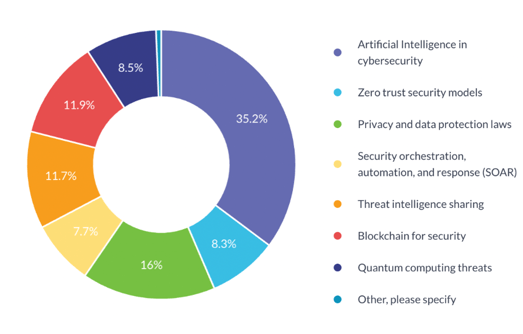
AI: Riding the Wave Without Wiping Out
Unsurprisingly, AI tops the charts as the trending topic for the industry, followed by Zero Trust security models. It is also the topic decision-makers are most interested in learning more about in the next six months.
Understand what your prospects consider the most pressing topics and - IF* relevant - ensure you are part of the conversation.
[*The IF here is key. If you don't have an authentic need to discuss a topic, don't do it. It'll hurt your brand if you are just seen as bandwagoning.]
Don't get caught out by buzzword bingo
How can you differentiate and begin to move beyond the buzzword? Your approach needs to be multifaceted. You need to engage in the latest conversations while staying clear of generic AI announcements. You need to delve deeper and focus on specific applications of AI within your cybersecurity solutions or important themes like regulation. Importantly, you need to bring it back to how it is going to help your clients, customers, and prospects. This showcases your expertise and avoids the trap of repetitive, uninformative rhetoric.
Where do you start?
- Always bring it back to why? Why should anyone care about this? Importantly, why should your customers, clients, prospects care? What impact in the near and long term will this have on their industry? What impact will it have on business in general and society at large?
- Leverage creative storytelling: Find new ways to talk about the topic. Luckily as a broad term, AI is moving so quickly that as long as your eye is on the news cycle, finding an innovative approach won’t be too difficult.
- Thought leadership needs thought leaders: Engage with the experts at your organisation. Find those with an interesting or new viewpoint you can leverage.
- Incorporate humour and creativity: Inject humour and creativity to make AI-related content more engaging and memorable. The secret sauce to engaging with your target audience is engaging with them as a human.
- The proof is in the pudding: Always back up what you say with social proof.
At Resonance, we are experts in helping organisations do just that.



Information on products
In cybersecurity, knowing where decision-makers look for answers is critical. Buyers use different sources at different stages, and understanding these patterns helps comms and marketing teams put the right messages in the right places. Our latest survey shows how cybersecurity decision-makers research products and services.
Search comes first
Traditional search engines remain the primary starting point, used by 53% of respondents. Strong SEO and clear, helpful content are still essential for visibility.
Media and events shape early understanding
Industry publications and webinars follow closely at 53% and 51%. PR and virtual events play a major role in building awareness and educating the market.
Analysts and conferences build trust
Trust matters in cybersecurity. Analyst reports and rankings influence 50% of buyers, while 43% rely on industry conferences. Authority and peer validation carry real weight.
Owned content supports decision-making
Nearly a third of buyers turn to vendor whitepapers, case studies and blogs. Practical, problem-led content helps move prospects from interest to intent.
AI is emerging as a research tool
Sixteen percent already use tools like ChatGPT to explore options. This points to a growing shift towards AI-led discovery.
A broad mix still matters
Email, social advertising and print all play supporting roles, reinforcing the need for a balanced, targeted channel mix.
One final point. Researching a problem is not the same as choosing a vendor. Visibility opens the door, but credibility and trust close the deal - and that's what Resonance's programmes are designed to support.
Shortlisting solutions
The criteria decision-makers use to shortlist cybersecurity solutions for further evaluations
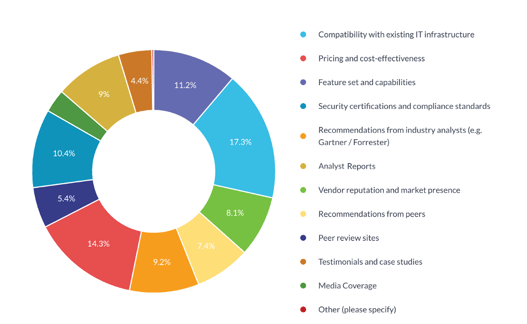
It’s no surprise the data reveals pricing and cost-effectiveness carries influence when it comes to shortlisting solutions. Cybersecurity leaders face the same commercial realities as everyone else – value is imperative even when protecting critical assets and data.
With media coverage bottoming out, followed closely by case studies, it’s a clear indication that when moving from the awareness to consideration stage the game changes. Your best chance as a marketer is to gain influence with analyst-focused outreach.
While headline elements like features and compliance dictate early selection, compelling analyst relations, customer evidence and media visibility offer ways cybersecurity comms teams can showcase credibility and technical excellence to give their solutions an edge. The art is in crafting solution stories that resonate.
How can YOU begin to navigate these muddy waters?
With stakeholders accessing information across multiple channels, comms strategies need an integrated approach that allows teams to "control the controllables". This means implementing coordinated public relations, analyst relations, inbound marketing, and content strategies that work together to amplify your messaging and meet your buyers with the right information, at the right point during the buyer journey.
At Resonance, our holistic communications programmes are designed to help cybersecurity organisations cut through the noise.
Our approach includes:
Public Relations: Our PR specialists secure high-impact coverage and thought leadership in national and top-tier technology media, profiling organisations as innovative market leaders. Our secret weapon is that we are the best newsjackers around, which allows us to inject our clients into timely news cycles while proactive pitching places key messages in leading publications.
Analyst Relations: We leverage long-standing analyst relationships to showcase innovation and drive adoption amongst influential advisory firms. These include Gartner, Keypoint Intelligence, and Everest Group, which ranked as the top three most trusted analyst firms for insights in our study. Analyst relations boost market awareness and validation, and as our research indicates, is the most important controllable aspect to get your products shortlisted.
Content: Resonance creates bingeable, snackable content optimised for search and shares. Branded and ghost-written long-form articles, blogs, infographics, and more, tell client stories that move audiences along the path to purchase.
Inbound Marketing: With SEO, email marketing, lead gen campaigns, and marketing automation, we fuel a flywheel effect - using content to attract and engage ideal prospects. Our inbound services increase site traffic, generate leads, and accelerate pipeline growth.
With an emphasis on meaningful measurement we deliver targeted awareness, increased consideration, and sales velocity. Our case study above proves just that.
Understanding the Complexities of Cybersecurity Decision-Making
Buying cybersecurity is rarely a neat, linear process. It’s political, high-stakes, and often slow. And that’s before you factor in the pressure of getting it wrong. For anyone trying to influence these decisions from the outside, understanding how they really get made is essential.
Every organisation is different, but the challenge is the same: you’re selling into a decision that involves multiple people, each with their own priorities, fears, and definitions of risk.
How many decision-makers are typically involved in the purchasing of a cybersecurity product/service
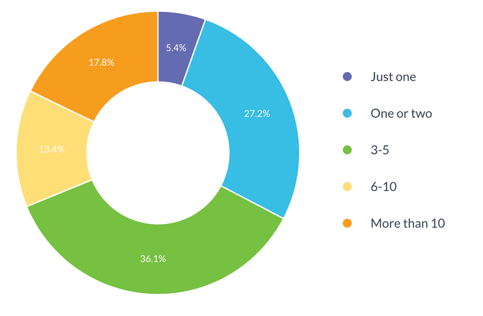
In most cybersecurity purchases, there isn’t a single “buyer”. It’s common for ten or more stakeholders to be involved, spanning security, IT, procurement, legal, finance, and senior leadership. And frankly, that makes sense. These teams aren’t just buying software, they’re choosing the armour that protects the organisation’s reputation, operations, and regulatory standing.
The implication is simple but often ignored: influence matters more than persuasion.
You can’t rely on one conversation, one champion, or one killer sales deck. You need to earn confidence across a group, over time, and in different ways. The CISO may care about threat coverage and architecture. Procurement will care about risk, contracts, and comparability. Leadership will care about credibility, stability, and whether choosing you is a defensible decision if something goes wrong.
This is where a joined-up communications strategy becomes critical.
A strong, credible presence, built through consistent visibility, high-quality PR, and meaningful participation in industry conversations, helps ensure you are already known and trusted before a buying process even begins.
Being visible in the right places, with the right messages, reduces perceived risk long before procurement gets involved.
Equally important is content that speaks to different stakeholders, not a single generic “buyer persona”. Practical thought leadership, case studies, and insight-led content help answer the quiet questions people are asking internally: Can we trust them? Do others like us use them? Will this stand up to scrutiny?
Distributed through the right channels, industry media, analyst conversations, and social platforms where decision-makers actually pay attention, this content helps your message land with the people who influence outcomes, not just those who sign contracts.
In complex cybersecurity purchases, success comes from sustained influence, not last-minute persuasion. The organisations that win are the ones that make choosing them feel informed, credible, and safe, across every stakeholder involved.
Leveraging Market Presence: Direct Engagement with Stakeholders
Market engagement is an exceptionally powerful tool that underpins any successful cybersecurity comms programme. As such, it’s imperative to actively participate in industry conferences, workshops, and webinars, and we constantly push our clients to do so. There aren’t any downsides, as this presence allows you to:
Showcase your thought leadership: Through presentations, demonstrations, and insightful discussions at cybersecurity events.
Network with key players: These events provide valuable opportunities to build connections with decision-makers, understand their specific needs, and address their concerns directly. These learnings can then be applied to the components of a holistic comms programme.
Build brand awareness: By actively and consistently participating in industry events, people will begin to know your brand, which will help establish your organisation as a trusted provider of cybersecurity solutions.
By implementing this multifaceted and strategic market approach, you will be able to establish your brand quickly, with important decision-makers. This coupled with effective thought leadership and AR outreach, will ensure that your prospects know who you are and how you can help them. Let’s also not forget that all the other components feed into this too, from newsjacking the latest stories to producing SEO-driven blog content.