Measured in the terms boards use.
Coverage is an output. We measure how communications changes reputation, risk, revenue and relationships, and the demand those signals influence.
See client results →Results that survive the board meeting.
We agree what success looks like before the work starts: the commercial objective, the audiences that influence it, and the measures your board already uses. That agreement is what turns a communications programme into something a board can judge.
From there, reporting is continuous rather than retrospective. Agentcy tracks coverage, share of voice, message adoption, AI visibility and the demand communications influences, so progress is visible between meetings and every number can be traced back to the work that moved it.
Four things boards already care about. Four things we measure.
Reputation
Share of voice, tier-one presence, message adoption and how AI systems describe the business.
Risk
Sentiment, issue tracking and readiness for the moments of scrutiny that test trust.
Revenue
High-intent engagement, inbound response and influenced demand connected to communications activity.
Relationships
The quality of third-party validation from media, analysts, investors and partners.
A live view, not a monthly archaeology project.
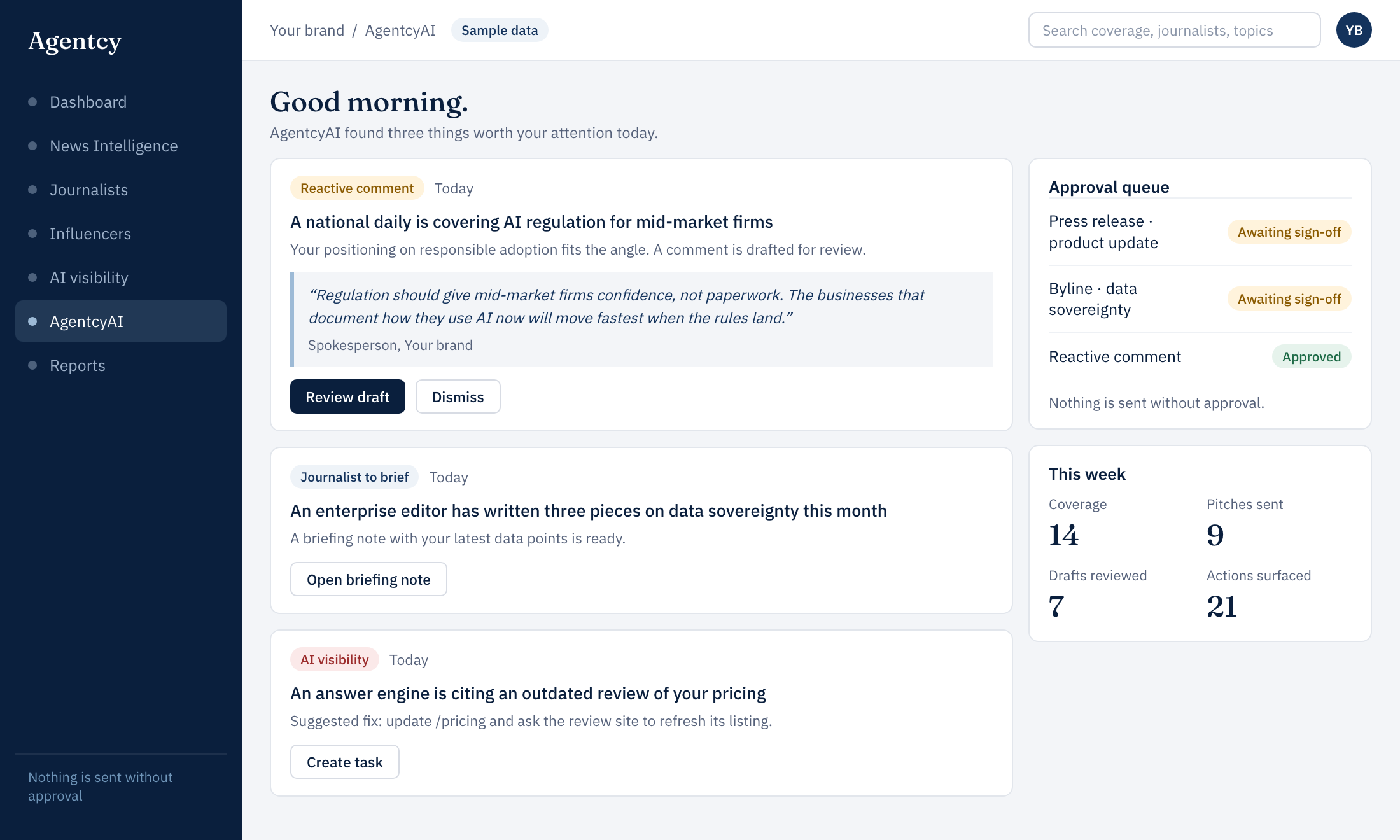
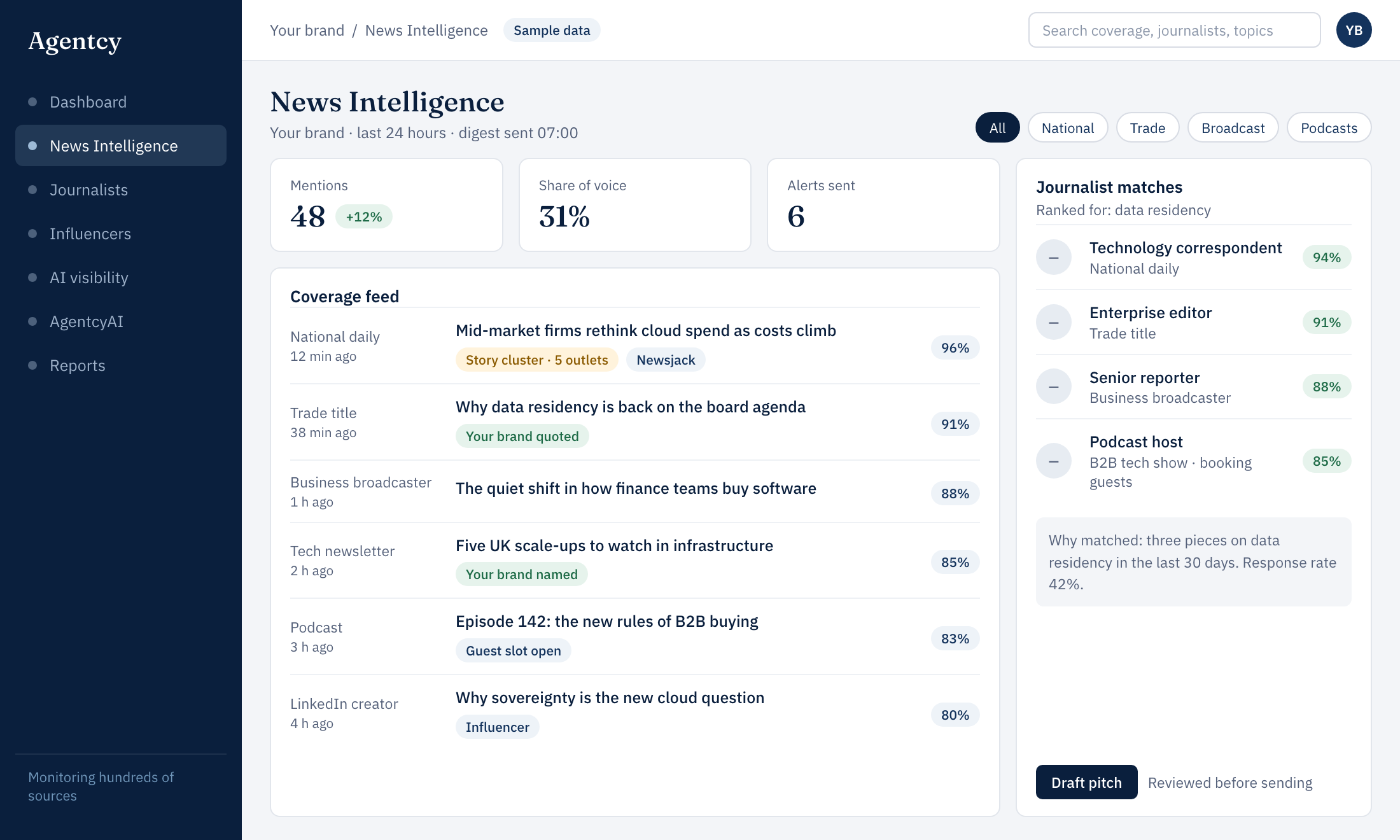
Agentcy connects media, social and AI visibility so the team can see what is changing, why it matters and where to act next.
Visibility
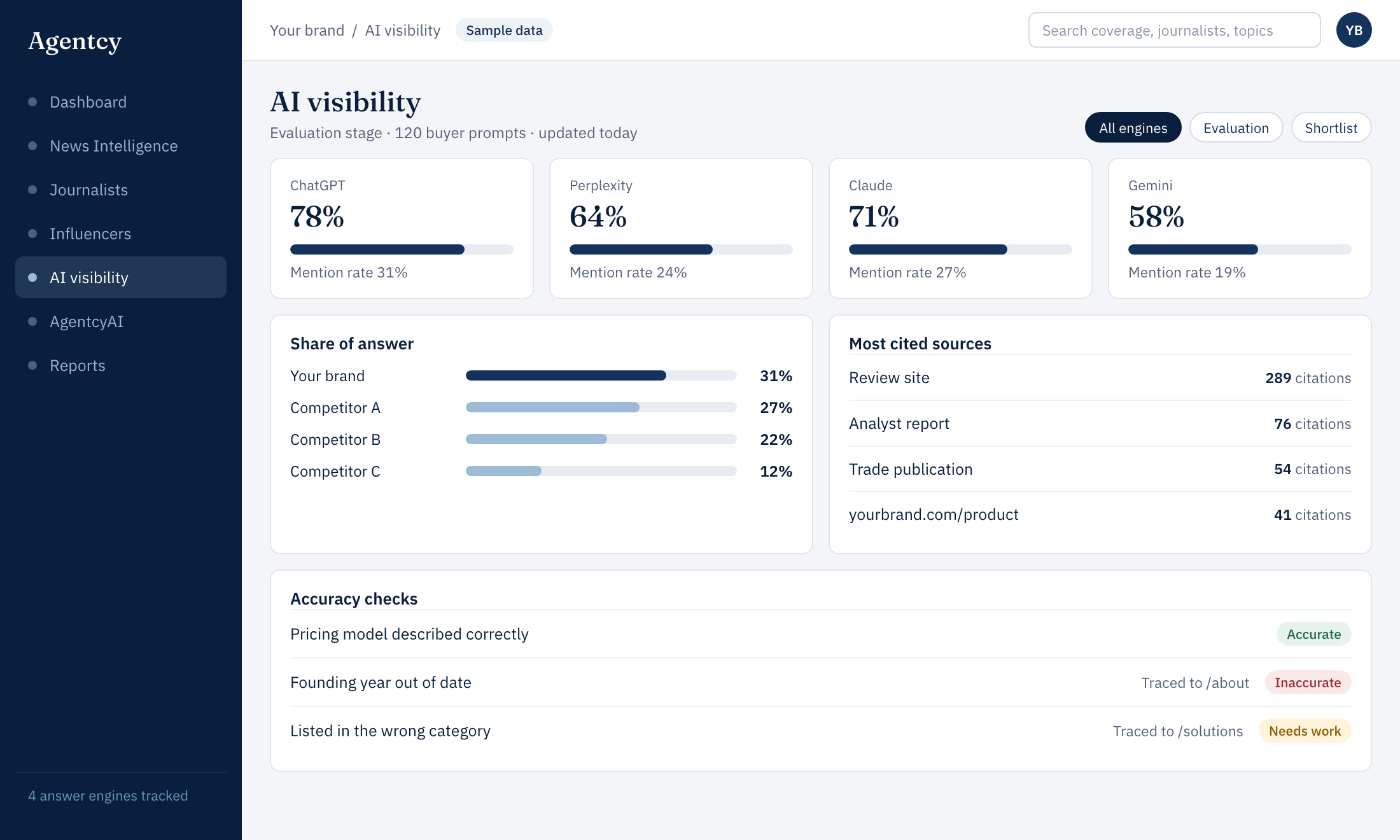
Coverage, share of voice and presence across AI answer engines.
Message adoption
Whether the market repeats the ideas and language you need to own.
Authority
The quality of third-party validation and executive influence.
Influenced demand
Commercial signals connected to communications activity.
About measurement.
What does Resonance report on in a communications programme?
Reputation, risk, revenue and relationships. In practice that means share of voice and tier-one presence, message adoption, sentiment and live issues, how AI answer engines describe the business, the quality of third-party validation, and the high-intent engagement and inbound response connected to the work.
Does Resonance use advertising value equivalent (AVE)?
No. AVE is treated as outdated across the industry: AMEC's Barcelona Principles have rejected it since 2010, and most serious measurement frameworks have followed. It prices coverage as though it were advertising, which tells a board nothing about whether perception changed. We report outputs, outreach and outcomes, in line with the AMEC framework.
How do you connect PR to revenue?
By following the signals between coverage and pipeline: high-intent visits and inbound enquiries after a moment, the accounts that engage, and whether buyers and the AI tools they consult repeat your positioning. We call it influenced demand rather than attribution, because communications rarely closes a deal on its own.
How often do clients get communications reporting?
Continuously. Agentcy keeps a live view of coverage, share of voice, message adoption and AI visibility, so the picture is current between reporting sessions and the formal report becomes a conversation about what to do next.
How long does PR take to show measurable results?
Some measures move within weeks: coverage, share of voice, and mentions in AI answers. Message adoption and the standing that survives a difficult moment take longer, usually two to three quarters, because they depend on repetition.
Should a board care about AI visibility?
Increasingly, yes. Buyers ask AI assistants for shortlists before they search, and those answers are built from third-party sources rather than your website alone. We report whether you appear, how you rank against competitors and whether what is said about you is accurate.
What do you need to set a reputation baseline?
Your category, the competitors that matter, the messages you need the market to repeat, and one commercial objective. That is enough to map where reputation stands today and what a programme would have to change.
Can you measure PR work done before we started?
Yes. The baseline covers what is already in market, including coverage and AI answers shaped by earlier work, so progress is measured from where you actually are.
What is AMEC?
AMEC is the International Association for the Measurement and Evaluation of Communication, the global industry body for communications measurement. Its Barcelona Principles set out what credible measurement looks like: agree the objectives first, measure outcomes rather than output, and never price coverage as advertising.
We report against AMEC's integrated evaluation framework, which is why our reporting runs from objectives through activity and outputs to the outcomes a board recognises. The framework is published at amecorg.com.
Do you measure against the AMEC framework?
Yes. Every programme starts by agreeing objectives and the measures attached to them, then reports in AMEC's terms: what we did, who it reached, what they took from it, and what changed as a result.
It keeps the conversation on what matters to the business rather than the volume of coverage, and it means our numbers stand comparison with anyone else reporting to the same standard. More at amecorg.com.
Know where your reputation stands today.
Your category, competitors, priority messages and one commercial objective are enough to map the first view.
Map the opportunity →