Influencer relations has grown up.
B2B buyers now listen to practitioners, podcasters and newsletter writers long before they speak to sales. Our research with 100 senior B2B marketers shows how far the channel has moved, and why it belongs in the PR programme next to media and analyst relations.
- Research
- April 2026
- Respondents
- 100 senior B2B marketers
- Also draws on
- CreatorIQ, LinkedIn, TopRank, Sprout Social
- Published by
- Resonance and Agentcy
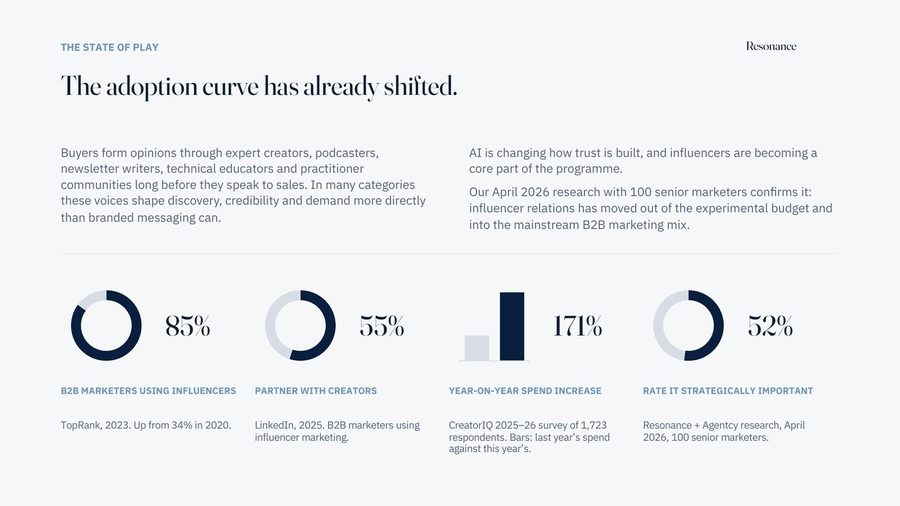
The adoption curve has already shifted.
Influencer relations has moved out of the experimental budget and into the mainstream B2B marketing mix. Adoption, spend and strategic priority are all up.
- 85%
- of B2B marketers use influencers, up from 34% in 2020TopRank, 2023
- 55%
- of B2B marketers partner with creatorsLinkedIn, 2025
- 171%
- year-on-year increase in creator spendCreatorIQ 2025–26, 1,723 respondents
- 52%
- rate influencer relations strategically importantResonance + Agentcy, April 2026
Creators are the newest trade press.
For twenty years B2B PR earned credibility through two groups: journalists and industry analysts. Buyers still read both. The circle of voices they trust has simply grown.
Practitioners post on LinkedIn. Hosts run podcasts for small, specialist audiences. Engineers explain products on YouTube, and operators write newsletters that land in exactly the inboxes you want to reach. These people deal in the same currency PR always has: independent, third-party credibility. Their audiences are often smaller than a trade title’s and far more concentrated among the people you sell to.
So we run influencer relations the way we run media and analyst relations. Research who matters. Build relationships over time. Give them evidence and access worth using. Measure what it does for reputation and for pipeline.
Map them like a media list
Which creators your buyers follow, what they publish, how often, and with how much authority. A ranked list that moves as the conversation moves.
Brief them like analysts
Data, customer proof and spokespeople with something to say. Practitioners take a brand seriously when it helps them do their job.
Measure them like earned media
Share of voice, message pull-through and AI visibility first, then the registrations, pipeline and revenue the programme touches.
What 100 senior B2B marketers told us.
Investment is rising and the channels are clear. The operating model has not caught up.
- 59%
- say industry practitioners and hands-on experts are among the most valuable independent voices
- 45%
- name LinkedIn creators, and the same share name YouTube, as their joint top priority channels
- 45%
- increased influencer relations investment over the last 12 months
- 10%
- have an established programme with a defined budget and process. 48% are still campaign-led or unstructured
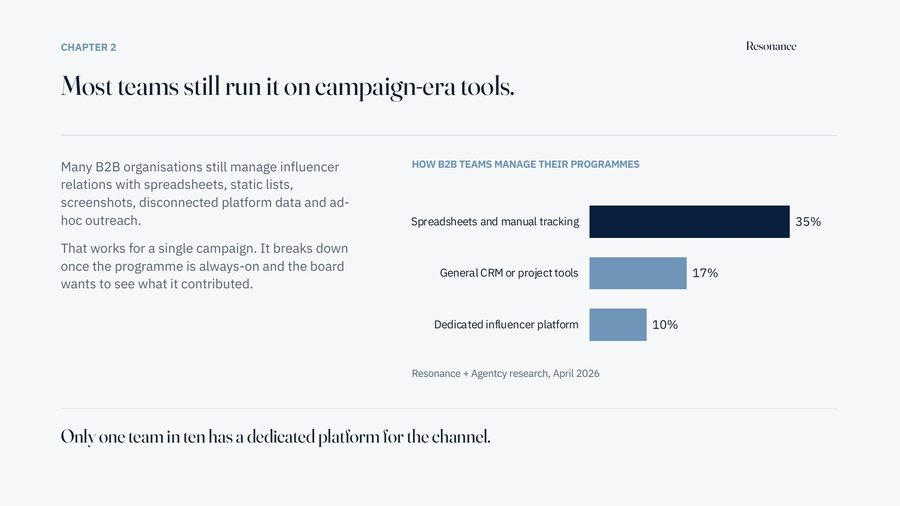
- 35%
- still manage the channel with spreadsheets and manual tracking. Only 10% use a dedicated platform
- 31%
- say measurement and proving ROI is the biggest blocker to scaling the programme
Source: Resonance + Agentcy research, April 2026. 100 senior B2B marketers.
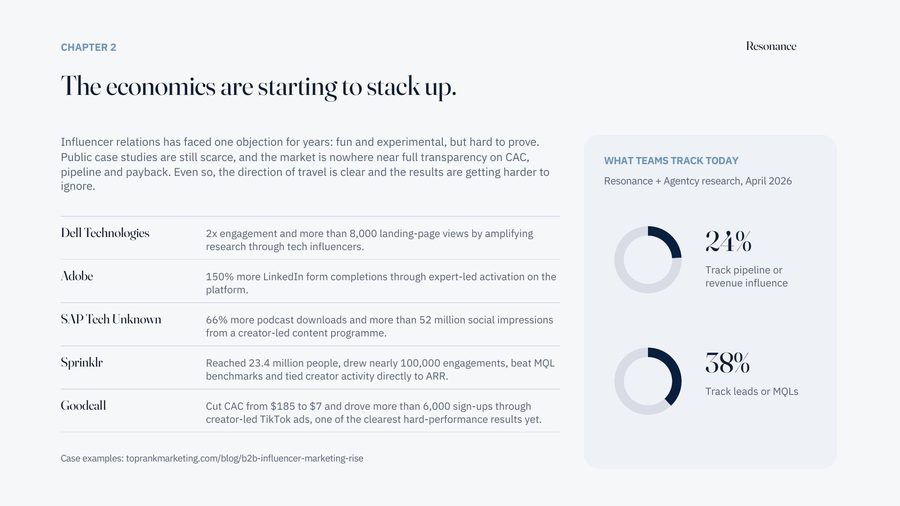
The numbers are starting to stack up.
Influencer relations has long been dismissed as fun but hard to prove. Public case studies are still scarce, and the direction of travel is clear all the same.
- Dell Technologies
- 2x engagement and more than 8,000 landing-page views by amplifying research through tech influencers.
- Adobe
- 150% more LinkedIn form completions through expert-led activation on the platform.
- SAP Tech Unknown
- 66% more podcast downloads and more than 52 million social impressions from a creator-led content programme.
- Sprinklr
- 23.4 million people reached, nearly 100,000 engagements, MQL benchmarks beaten and creator activity tied directly to ARR.
- Goodcall
- CAC cut from $185 to $7, with more than 6,000 sign-ups from creator-led TikTok ads.
Three structural gaps.
Most teams still run the channel with campaign-era tools: spreadsheets, static lists, screenshots and ad-hoc outreach. Three gaps follow from that.
Discovery
Teams often don’t know which expert voices shape their category across LinkedIn, podcasts, Substack, YouTube and technical communities.
Context
Even when they know the names, they lack a live view of what those people are saying, which topics are rising, or where a brand could credibly contribute.
Measurement
Most organisations still can’t connect creator activity cleanly to the CRM, to pipeline and revenue, or to wider brand visibility.
Why it matters even more now.
Influence no longer stops at the original post. A credible creator mention can shape how a buyer sees a category on LinkedIn, hears about it on a podcast, meets it in a newsletter or searches for it on YouTube.
It also feeds the answers AI assistants give. When a buyer asks ChatGPT, Perplexity or Google which vendors lead a category, the answer is built from what credible, independent sources have published, and podcast transcripts, newsletters, LinkedIn posts and YouTube explainers are part of that record. For anyone planning AI visibility, influencer relations now sits on the same list as media relations and analyst relations.
- BrandLink has grown into a more formal publisher and creator environment.
- TikTok
- Now talks about lead quality and pipeline measurement through its HubSpot integration.
- YouTube
- Creator Partnerships makes discovery, permissions and performance analysis far more native.
Influencer relations, run like PR.
The same discipline we bring to journalists and analysts, with Agentcy providing the intelligence and the measurement.
Find the voices
Agentcy maps the creators, hosts and writers your buyers follow across LinkedIn, YouTube, Substack, podcasts, Instagram and TikTok, ranked by relevance to your category.
Build the relationships
Regular contact, early access, briefings and a steady supply of useful evidence, the way we look after journalists and analysts.
Create the openings
Podcast guest spots, newsletter contributions and co-created content, matched to the topics your market is discussing. Usage rights and disclosure agreed up front.
Measure it like PR
Share of voice, message pull-through and AI visibility in one view with your media and analyst coverage, with a line through to pipeline.
Read it in full.
Fifteen pages on adoption, the economics, the structural gaps holding B2B teams back, and what an always-on influencer programme looks like. Free, with no form to fill in.
Download the PDF- Pages
- 15
- Format
- PDF, 2.9 MB
- Research
- April 2026
Explore it with AI. Ask an assistant to summarise the findings for your own programme.
Influencer relations, briefly.
What is B2B influencer relations?
It is the work of building long-term relationships with the independent voices B2B buyers trust: practitioners, podcast hosts, newsletter writers, technical educators and analysts who publish on LinkedIn, YouTube and Substack. It runs much like media relations, with creators alongside journalists.
How is influencer relations different from influencer marketing?
Influencer marketing usually means paid creator activity bought one campaign at a time. Influencer relations is the always-on, relationship-led discipline that sits next to media and analyst relations. The report found always-on programmes outperform one-off campaigns, yet only 10% of B2B teams have an established programme.
How do you measure B2B influencer relations?
Start with the measures PR already uses: share of voice, message pull-through and visibility in AI answers. Then connect creator activity to registrations, lead quality, pipeline and revenue in the CRM. Only 24% of B2B teams track pipeline or revenue influence today, and 31% say proving ROI is the biggest blocker to scaling.
Who took part in the research?
Resonance and Agentcy surveyed 100 senior B2B marketers in April 2026. The report also draws on published data from CreatorIQ, LinkedIn, TopRank and Sprout Social.
Build the operational muscle for influence.
Resonance runs media, analyst and influencer relations for B2B technology brands, with Agentcy supplying the intelligence and measurement behind the programme.
Talk to Resonance More research