The AIIM framework.
A targeted approach to analyst relations. Score the analysts in your market on influence, impact and market buy-in, rank them, and spend your time on the ones who move buyers.
- For
- CMOs and analyst relations teams
- Scores
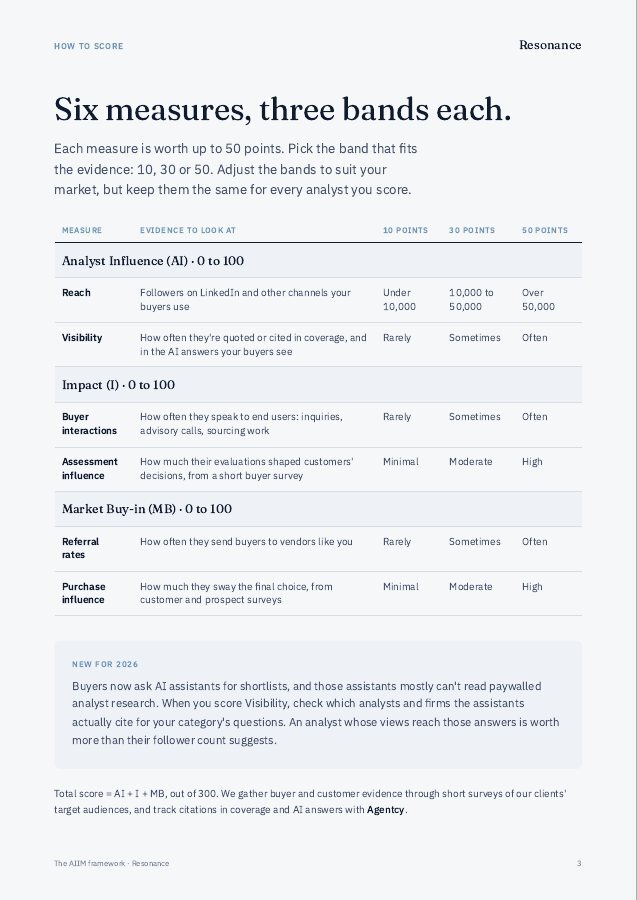
- Six measures, 300 points
- Format
- PDF guide and Excel template
- Written by
- Claire Williamson, Resonance
Analyst relations isn't a numbers game.
Briefing every analyst who covers your market spreads your time thin and wins you little. The analysts who matter are the ones whose views reach your buyers when they're deciding. AIIM helps you find them, and it scores on evidence.
Analyst Influence
How far the analyst's voice carries: their reach, and how often they're quoted and cited, including in AI answers. Up to 100 points.
Impact
How much they change what buyers do: how often they talk to buyers, and how much their assessments weigh. Up to 100 points.
Market Buy-in
How much the market trusts them: whether they send buyers to vendors and sway the final decision. Up to 100 points.
Score, rank, tier, plan.
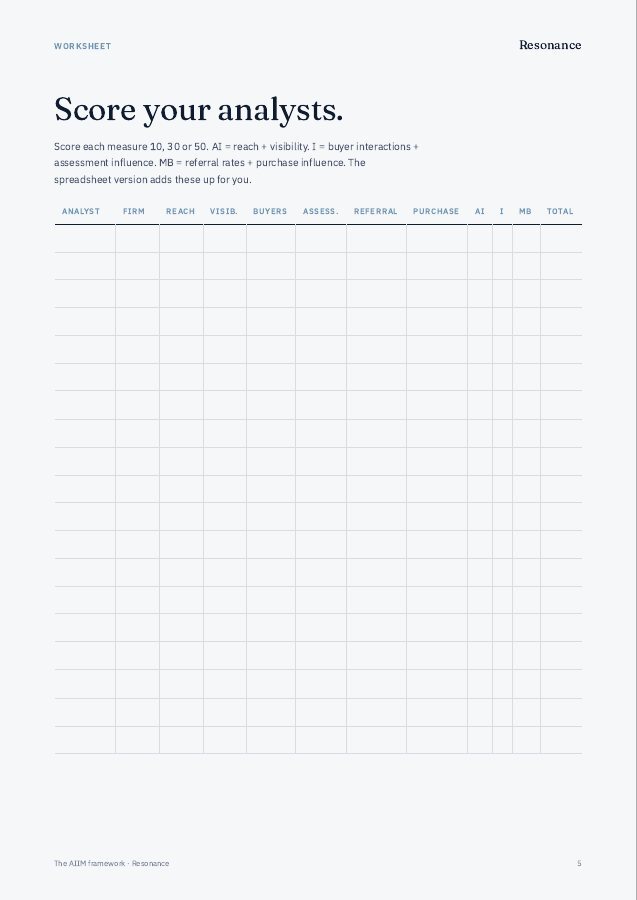
The guide takes you through each step, with a scoring rubric, a worked example and a worksheet. The Excel template adds up the scores and sets the tiers for you.
List the analysts
Everyone who covers your market: the big firms, specialists, regional firms and sourcing advisers. See the firms in our guide.
Gather the evidence
Reach, citations in coverage and AI answers, buyer conversations and customer surveys. Ask your sales team which analysts come up.
Score and rank
Each of six measures is 10, 30 or 50 points. Add them up for a total out of 300 and rank the list.
Tier and plan
Brief Tier 1 before every announcement, Tier 2 twice a year, and keep Tier 3 informed in writing. Rescore every six months.
Take it into your next planning meeting.
The PDF explains the framework, the scoring bands and how to turn the ranking into a plan, with a printable worksheet. The Excel template does the arithmetic and draws the chart. Both are free, with no form.
- Guide
- 6-page PDF
- Template
- Excel, with formulas
- Edition
- 2026
Try it with AI. Ask an assistant to help you apply AIIM to your own market.
More on analyst relations.
The analyst relations guide
What AR is, what it's worth, how AI is changing it and how to build a programme.
Introducing AIIM
Claire's original article on the thinking behind the framework.
Our analyst relations agency
Programmes and ranking report support, run for you. Includes a free AR health check.
AIIM, briefly.
What is the AIIM framework?
AIIM is Resonance's framework for deciding which industry analysts to prioritise. It scores each analyst on Analyst Influence (reach and visibility), Impact (how often they talk to buyers and how much their assessments weigh) and Market Buy-in (referrals and influence on the final purchase), each out of 100, for a total out of 300.
What does AIIM stand for?
Analyst Influence, Impact and Market Buy-in: the three things the framework scores for every analyst.
How do you score an analyst with AIIM?
Each of six measures is worth 10, 30 or 50 points, depending on the evidence: reach, visibility, buyer interactions, assessment influence, referral rates and purchase influence. Add the pairs to get the three scores, then add those for a total out of 300.
How should you use the scores?
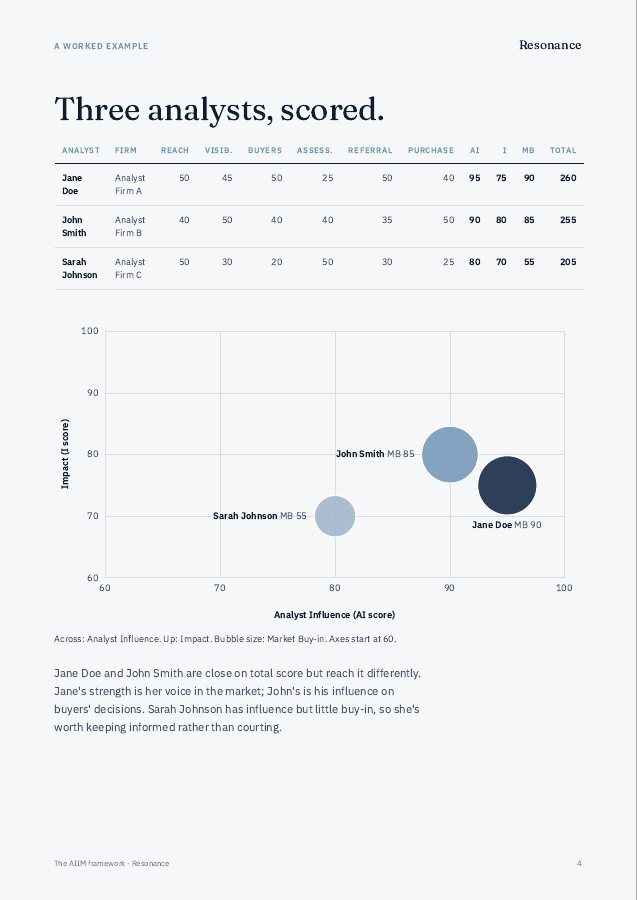
Rank the analysts and put them in tiers. As a starting point, brief Tier 1 (200 and above) before every major announcement, Tier 2 (120 to 199) twice a year, and keep Tier 3 informed in writing. Rescore every six months.
Is the AIIM template free?
Yes. The PDF guide and the Excel template are free to download, with no form to fill in.
How does AI change which analysts matter?
Buyers now ask AI assistants for shortlists, and those assistants mostly can't read paywalled analyst research. When you score Visibility, check which analysts and firms the assistants actually cite for your category's questions.
Want us to score your analysts with you?
A 45-minute review of your analyst relations, followed by a written report on the gaps and the opportunities, including which analysts your programme should be spending time on.
Book a health check More research