What AI gets wrong about B2B tech brands.
We checked almost 50,000 AI answers about 116 B2B technology companies against the facts. Two in three got something wrong, and we traced where each mistake came from.
- Answers checked
- Almost 50,000
- Companies
- 116 in B2B technology
- Period
- April to September 2026
- Data
- Agentcy, our AI visibility platform
Most answers get something wrong, usually something small.
We asked ChatGPT, Gemini, Perplexity and others the questions B2B buyers ask, then checked each answer against verified facts. The assistants were warm about the companies, but often out of date on the detail.
- 65%
- of answers had at least one error about the company
- 15%
- had an error our judge rated serious, roughly one answer in seven
- 4.5
- verified facts left out of the average answer, more than twice the number of errors
Source: Agentcy accuracy checks on almost 50,000 answers about 116 B2B technology companies, April to September 2026.
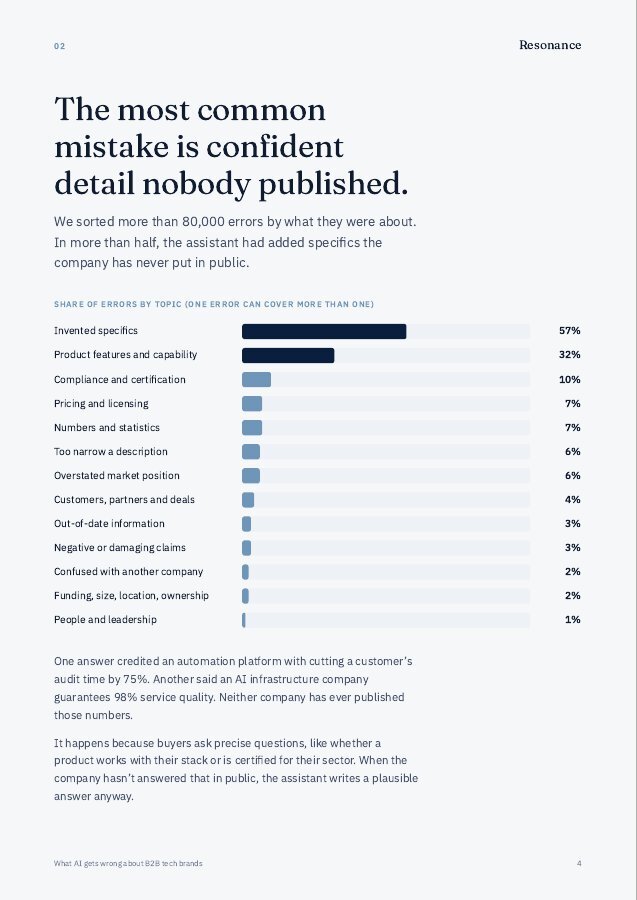
The most common mistake is confident detail nobody published.
In more than half of the 80,000-plus errors we found, the assistant had added specifics the company never put in public. Buyers ask precise questions, and when nobody has answered them, the assistant writes a plausible answer anyway.
One error can cover more than one topic.
One answer credited an automation platform with cutting a customer’s audit time by 75%. Another said an AI infrastructure company guarantees 98% service quality. Neither company has ever published those numbers. (Our examples are composites, and we don’t name any company.)
Positioning goes wrong both ways. A broad automation platform was called mainly an RPA tool, and a fund data provider became the most widely used network in Europe. Errors about funding, pricing and people are rarer, but more often serious.
AI leaves out more than it gets wrong.
The average answer missed four or five verified facts, and a reader can’t spot what isn’t there. A third of the gaps were products a company added after it first became known. Another fifth were security, data residency and certifications, which buyers in regulated sectors look for first.
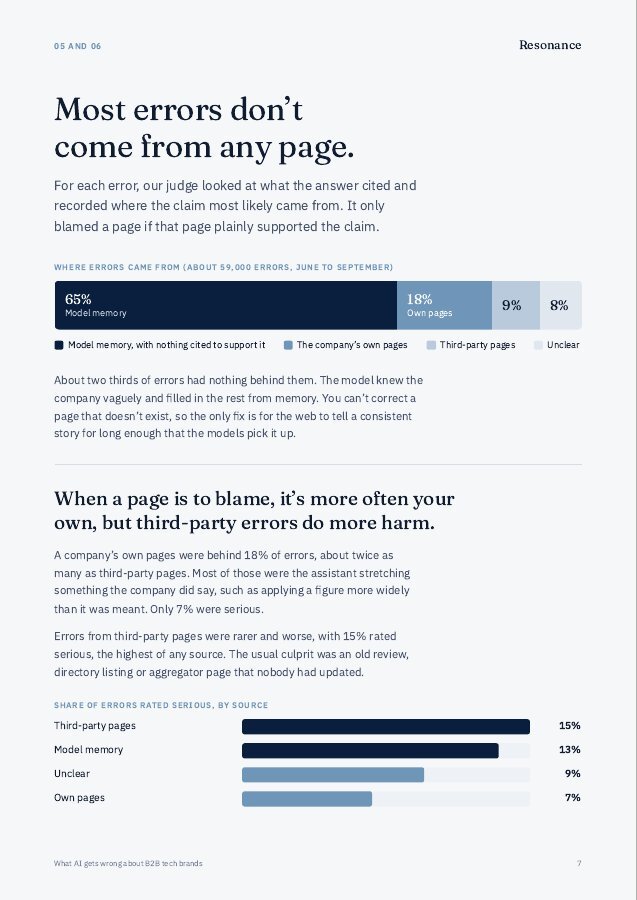
Most errors don’t come from any page.
Our judge only blamed a page when that page plainly supported the wrong claim. About two thirds of errors had nothing behind them. The model knew the company vaguely and filled in the rest from memory.
About 59,000 errors with a recorded source, June to September 2026.
When a page is to blame, it’s more often your own, but third-party errors do more harm.
Own pages were behind twice as many errors as third-party pages, mostly the assistant stretching something the company did say. Only 7% of those were serious. Third-party errors were rarer and worse, at 15% serious, usually from an old review or directory listing.
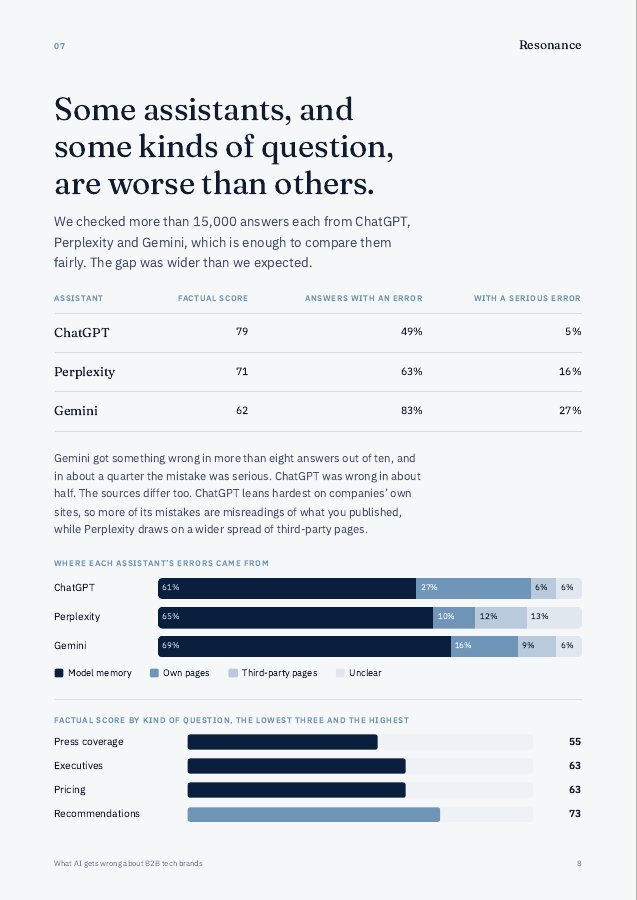
Some assistants, and some kinds of question, are worse than others.
Gemini got something wrong in more than eight answers out of ten, and ChatGPT in about half. Questions about a company’s press coverage, executives and pricing scored lowest.
| Assistant | Factual score | Answers with an error | With a serious error |
|---|---|---|---|
| ChatGPT | 79 | 49% | 5% |
| Perplexity | 71 | 63% | 16% |
| Gemini | 62 | 83% | 27% |
Factual score out of 100, from more than 15,000 checked answers per assistant.
It’s getting harder to pass.
ChatGPT’s factual score slipped from 86 in April to 72 in September, and the others dipped too. Part of that is our fact packs getting more detailed. About one error in ten came back in later answers, so mistakes tend to stick.
What we’d fix first.
Most errors fill a gap, so the work is closing gaps in public. We’d start with your own site because it’s quickest.
Publish the details buyers ask about
Pricing approach, certifications, integrations and data residency, in plain text on a dated page.
Read your own pages like an assistant
Look for loose claims that could be stretched, old product names and figures with no context.
Correct the third-party pages with most reach
Update your review site and directory profiles, and ask for corrections where you can.
Check again every month
Ask your buyers’ questions and track the errors that come back. Judge progress over a quarter.
Read it in full.
Twelve pages that follow the story from the first check to what we’d fix first, with the charts and a note on how we did it. It’s free, and there’s no form.
Download the PDF- Pages
- 12
- Format
- PDF, 0.8 MB
- Data
- April to September 2026
Try it with AI. Ask an assistant to help you check what it says about your company.
More from our AI citation research.
What AI reads before it recommends
The content types and page features that AI assistants cite most, from over 1.3 million citations.
Earned media in the age of AI answers
Which media titles the assistants read for B2B tech, and why trade and specialist press come out on top.
The UK B2B Tech PR AI Visibility Index
Which agencies the assistants recommend, measured every week.
Questions we get asked about AI accuracy.
How accurate are AI assistants about B2B technology companies?
Mostly right on tone and loose on detail. When we checked almost 50,000 answers about 116 B2B tech companies, 65% had at least one error and about one in seven had a serious one. They also left out four or five verified facts per answer, and often described companies as they were a year or two ago.
What kind of mistakes does AI make about companies?
The most common is invented detail. In more than half of the errors we found, the assistant added a figure, feature, integration or certification the company had never published. Errors about funding, pricing and people are rarer, but they're the most likely to be serious.
Do AI errors come from a company's own website or from other sites?
Usually neither. About two thirds of errors had nothing cited behind them, so the model was working from memory. When a page was to blame, it was the company's own site about twice as often as a third-party one, though third-party errors were twice as likely to be serious (15% against 7%).
Which AI assistant is most accurate about B2B brands?
ChatGPT, of the three we could compare fairly. It got something wrong in about half its answers and had a factual score of 79 out of 100. Perplexity scored 71 and Gemini 62, with an error in more than eight of every ten Gemini answers.
What does AI leave out about companies?
Mostly the breadth of what they sell. About a third of missed facts were about products a company added after it first became known. Security, data residency and certifications made up another fifth.
How can a company fix what AI says about it?
Start with your own site, because it's quickest. Publish the details buyers ask about, like pricing approach, certifications and integrations, in plain dated text, and tidy loose claims an assistant could stretch. Then correct the review sites and directories that carry the worst errors, and check again every month.
How was the research done?
Agentcy, our AI visibility platform, collected the answers between April and September 2026. An AI judge compared each one with a verified fact pack for the company and logged every wrong claim, how serious it was and, from June, where it most likely came from. We don't name any company in the report.
Find out what AI says about you before your buyers do.
We’ll check what the assistants say about your company and trace where the mistakes come from. Then we’ll help you fix them, starting with the pages you control.
Talk to Resonance More research